Why Diversification Sometimes Feels Wrong Before It Works
Why a portfolio designed for your financial life may look disappointing beside the market’s latest winner.
By Billy Desai, MBA, CFA, CFP®
CEO and Founding Partner, Analog Capital Partners. Analog Capital Partners
Diversification can feel wrong because it means owning investments that are not leading the market. When one asset class surges, a diversified portfolio will often lag behind it. The purpose is not to win every comparison. It is to reduce dependence on any single investment or market outcome—not to guarantee profits or prevent losses. Investor
Imagine opening your investment statement after a strong year.
Your portfolio has grown. Your retirement plan has not materially changed. You still have the flexibility to fund the things that matter.
Yet you feel disappointed.
A stock index did better. A friend made more money in a handful of companies. The investments you own outside the stock market suddenly look unnecessary.
You begin asking a reasonable question:
Why own the things that are holding us back?
That question sits at the heart of one of investing’s most difficult trade-offs. Diversification is easy to appreciate in principle. It becomes harder to maintain when its opportunity cost is visible and the risks it addresses have not materialized.
At Analog Capital Partners, we believe this deserves a better explanation than “stay the course.”
Investors should understand what their portfolios own, why those investments belong together, when the approach may disappoint, and what would justify a change.
The purpose of diversification is not to make every holding look smart at the same time. It is to avoid needing one part of the portfolio to be right all the time.
What does it mean for diversification to “work”?
Diversification means spreading exposure across investments rather than relying excessively on one holding or source of risk. It does not mean that every investment will rise, or that losses in one area will always be offset elsewhere. Investor
For a family’s portfolio, we believe the practical objective is broader: pursue the growth the financial plan requires while keeping risk consistent with what the family can reasonably bear.
That distinction changes how success should be evaluated.
A portfolio might be doing its intended job while trailing an all-stock index. It might be providing liquidity for planned spending, limiting a concentration that already exists elsewhere in the family’s finances, or maintaining a deliberate balance between growth and risk.
None of those benefits requires every holding to outperform.
The title of this article also needs an important qualification: “before it works” does not mean an underperforming investment is guaranteed to recover or that a diversified portfolio will eventually beat stocks.
Reducing concentration can be useful from the day a portfolio is constructed. The benefit simply may not appear as a higher return on the next statement.
And sometimes, an investment or strategy genuinely needs to change.
The challenge is distinguishing discomfort from evidence.
Why does diversification feel most frustrating when markets are strong?
A powerful market rally creates an unusually persuasive comparison.
The winning asset is easy to identify. Its return is visible. The alternative history—what might have happened under less favorable conditions—is not.
Imagine a hypothetical investor holding equities alongside investments selected for other purposes. When equities outperform those other holdings, the investor can calculate exactly how much more an all-equity portfolio would have earned.
That calculation is real.
What it does not answer is whether accepting the additional equity exposure would have been appropriate before the outcome was known.
This is the difference between judging a decision and judging a result.
A sound decision can produce a disappointing outcome. An imprudent decision can produce an excellent outcome. One period of performance cannot, by itself, distinguish the two.
There is also an emotional asymmetry. During a rally, the cost of diversification can feel immediate and personal: we could have made more. The risks associated with a more concentrated portfolio may remain abstract.
But an investment does not become less risky merely because its recent returns have been attractive.
That does not make concentrated investing inherently wrong. It means concentration should be a deliberate choice, with consequences the investor understands—not an allocation that emerges from repeatedly abandoning whatever has recently lagged.
The opportunity cost of diversification is real
It would be misleading to describe every frustration with diversification as a behavioral mistake.
There can be a genuine financial trade-off.
Replacing part of an equity allocation with more conservative investments may reduce long-term growth potential as well as risk. Holding assets for liquidity or stability can involve accepting lower expected returns. A portfolio can also be too conservative for the objectives it needs to fund. Fidelity
The answer is not to dismiss that cost. It is to evaluate what the investor receives in exchange.
Consider two hypothetical households.
One is accumulating wealth, has substantial earned income, and does not expect to draw on investments for many years.
The other relies on its portfolio to pay living expenses, support family members, and fund near-term commitments.
Even with the same account balance, those households face different decisions. A market decline that is tolerable for one may disrupt the other’s plans.
The appropriate question is therefore not:
Which allocation would have produced the highest return recently?
It is:
What balance of growth, liquidity, and risk best supports the responsibilities this money carries?
A diversified portfolio should not be designed to eliminate all discomfort. That would be an unrealistic objective. It should make the trade-offs explicit enough that the investor can decide whether they are worthwhile.
Owning more investments is not the same as being diversified
A portfolio can contain many holdings and still depend heavily on the same outcome.
Several exchange-traded funds may own overlapping companies. Individual stock positions may duplicate those exposures. Different account statements can conceal similar underlying risks. FINRA specifically warns that holding multiple funds does not, by itself, eliminate concentration risk. FINRA
The useful question is not simply, “How many investments do we own?”
It is, “What could hurt several of these investments at the same time?”
That question should extend beyond the brokerage account.
Consider an executive whose salary, future compensation, and substantial stock holdings all depend on one employer. Or a business owner whose largest asset is an operating company, while the liquid portfolio is heavily exposed to similar economic conditions.
In those hypothetical situations, the investment account cannot be evaluated intelligently in isolation.
Our view is that diversification should begin with the family’s economic exposures, not the number of line items on a statement.
A portfolio with fewer, clearly understood components may be more deliberate than a much larger collection of overlapping investments.
Complexity is not evidence of diversification. Different labels are not evidence of different risks.
What market history teaches—and what it does not
History provides useful examples of both diversification’s value and its limitations.
During the calendar decade from 2000 through 2009, the S&P 500’s cumulative return was negative even with dividends included, according to NYU’s historical return series. That is a reminder that a long investment horizon does not guarantee a satisfactory outcome from one market segment. Stern School of Business
In 2008, the same dataset shows sharply negative stock returns alongside positive returns for its 10-year U.S. Treasury bond series. In 2022, both series declined. An exposure that helped in one difficult period did not provide the same offset in another. Stern School of Business
The lesson is not that bonds always protect investors, that stocks should be avoided, or that the next difficult period will resemble the last.
It is that portfolio construction should account for more than one possible environment.
Historical examples are not a schedule of future events. Nor do they establish how an Analog portfolio would have performed.
They help us ask better questions about dependence, vulnerability, and the limits of our assumptions.
Why avoiding a deep loss can matter more than winning a strong year
Investment returns compound on the capital that remains.
That creates an asymmetry between losses and recovery.
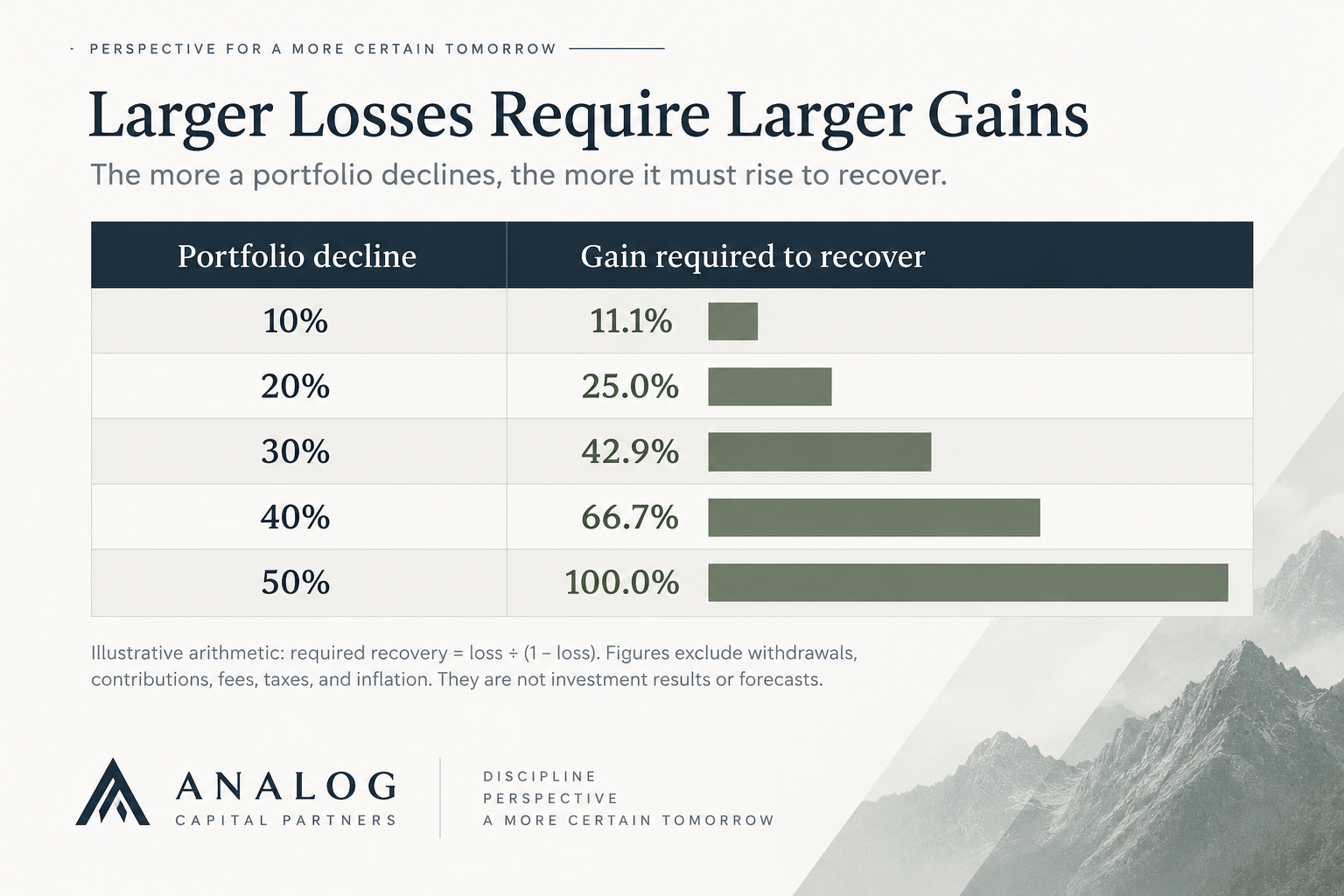
A portfolio that falls from $1 million to $500,000 needs a 100% gain to return to its starting value. A subsequent 50% gain would bring it only to $750,000.
This is why we believe the depth of a decline belongs in the same conversation as the pursuit of returns.
However, the arithmetic should not be misused.
It does not prove that the portfolio with the smallest decline will finish with the most wealth. An excessively defensive portfolio can fall short because it does not generate enough growth. Nor does diversification guarantee a smaller decline.
The practical objective is to consider both sides: the growth needed to support the plan and the losses that could undermine it.
For a family with ongoing financial commitments, “How much might we earn?” is incomplete without “What happens if the path is much worse than expected?”
Why diversification matters differently in retirement
For an investor taking withdrawals, the order of returns matters—not just their average.
Sequence-of-returns risk is the risk that unfavorable returns, particularly early in retirement, interact with withdrawals in ways that weaken the portfolio’s ability to support future spending. Money withdrawn during a decline is no longer invested to participate in a recovery. Schwab Brokerage
A simplified example illustrates the issue.
Suppose two hypothetical investors each begin with $1 million and withdraw $50,000 at the end of each year.
The first experiences a 20% loss followed by a 25% gain. After the two withdrawals, the portfolio ends at $887,500.
The second experiences the same returns in reverse order: a 25% gain followed by a 20% loss. After the same withdrawals, the portfolio ends at $910,000.
Without withdrawals, both return sequences would finish at $1 million. With withdrawals, the order creates a $22,500 difference.
This is a two-year mathematical illustration, not a forecast, recommended withdrawal rate, or representation of any investment strategy. It excludes taxes, fees, inflation, and other real-world factors.
The planning implication is important: a retirement portfolio cannot be evaluated solely by the average return an investor hopes to receive.
Our approach is to examine how investments, spending, liquidity, and flexibility work together.
A person may have a retirement horizon measured in decades and a spending horizon measured in months. Both deserve attention.
Why rebalancing can feel like doing the wrong thing
Rebalancing means adjusting a portfolio when market movements take it away from its intended allocation.
It can involve reducing an exposure that has performed well and directing capital toward an exposure that has lagged. That can feel uncomfortable precisely because recent performance makes the winner look more appealing. Rebalancing may also generate taxes and transaction costs. FINRA
The distinction we emphasize is between maintaining a portfolio and predicting a market reversal.
Reducing an overweight position does not necessarily mean believing that investment is about to fall. Restoring an underweight allocation does not necessarily mean believing it is about to surge.
It can simply mean that the portfolio has drifted beyond the risk exposures originally intended.
Imagine deciding in advance that a particular allocation is appropriate, then allowing a strong rally to make that allocation substantially larger. Leaving it untouched is still a decision. It allows recent market performance to reshape the portfolio.
Rebalancing is not guaranteed to improve returns. Trimming an exposure that continues rising can leave the portfolio behind an unrebalanced alternative.
Its rationale is discipline, not clairvoyance.
The portfolio should reflect a considered investment policy—not merely the accumulated consequences of whatever has recently performed best.
When should a disappointing portfolio actually change?
Diversification must not become a defense against scrutiny.
An investor is entitled to ask why a portfolio has disappointed, what risks were taken, what costs were incurred, and whether the strategy remains appropriate.
“We are diversified” is not a complete answer.
We believe a useful review should address four questions.
Does each allocation still have a clear purpose?
An investment should have a reason to be owned beyond “we have always held it.”
That reason should explain its intended contribution, its principal risks, and the circumstances in which it could disappoint.
Persistent underperformance does not automatically invalidate the rationale. But a rationale that cannot be explained or tested deserves attention.
Are the investments behaving as reasonably expected?
There is a difference between an allocation experiencing a known vulnerability and an allocation exposing the portfolio to risks that were not understood.
A review should investigate that difference rather than assume every disappointing outcome is normal.
The aim is not to demand perfect forecasts. It is to check whether the portfolio’s underlying assumptions remain defensible.
Is implementation adding unnecessary friction?
Fees, taxes, trading decisions, overlapping exposures, and liquidity constraints should be examined—not hidden behind a long-term narrative.
Two portfolios with similar stated philosophies can deliver materially different investor experiences because they are implemented differently.
A sophisticated explanation is not a substitute for an efficient, understandable portfolio.
Does the strategy still fit the family?
A business sale, retirement, inheritance, major purchase, or change in spending needs can alter what a portfolio must accomplish.
The right reason to change an allocation may have little to do with the market.
Conversely, changing an otherwise suitable strategy solely because another investment has recently performed better may solve the feeling of disappointment without solving the underlying planning problem.
Patience should be supported by evidence. Discipline should include the willingness to revise a decision when the facts change.
What is the right benchmark for a diversified portfolio?
We believe a portfolio deserves two complementary assessments.
The first is an investment assessment: how did it perform against an appropriate, investable comparison, considering its exposures, risk, and costs?
The second is a planning assessment: how well does it support the household’s spending, liquidity, and long-term objectives?
Neither assessment should replace the other.
An all-stock index may be useful context, but it does not fully evaluate a portfolio deliberately holding meaningful non-equity exposures. Equally, a reassuring financial plan should not be used to avoid examining poor investment execution.
A fair review should explain where the performance difference came from.
Was it primarily the asset allocation? Security selection? Fees? Trading? A deliberate tax constraint? A risk the investor consciously chose to avoid?
Those are different explanations with different implications.
The benchmark should not be changed opportunistically after results are known. Nor should the best-performing asset of the period become the portfolio’s new standard by default.
Investors deserve accountability without hindsight becoming the investment policy.
How Analog Capital Partners approaches diversification
Analog Capital Partners’ Cross-Cycle investment approach combines quantitative equity selection, different sources of return, and systematic rebalancing. Its objective is to pursue long-term growth while reducing dependence on a single market environment—not to predict every turning point. Analog Capital Partners
Three complementary disciplines support the approach.
Analog Equity applies Quality and Momentum research to U.S. large-cap stock selection.
Analog Diversify combines equity exposure with investments such as U.S. Treasuries, precious metals, and real estate, with a defined role for each allocation.
Analog Rebalance monitors allocation drift and applies systematic rules, while considering taxes, liquidity, and withdrawals. Analog Capital Partners
The appropriate portfolio depends on the client’s circumstances. Cross-Cycle portfolios can lose money, trail conventional stock-and-bond portfolios, and experience periods when diversifying investments decline together. The name describes an approach, not a guaranteed outcome. Analog Capital Partners
The standard we believe investors should expect is straightforward: understand why the portfolio is built as it is, understand its trade-offs, and evaluate it consistently.
Diversification advice in Houston, Austin, Frederick, and Naples
Analog Capital Partners is a Houston-headquartered, fee-only registered investment adviser with offices in Austin, Texas; Frederick, Maryland; and Naples, Florida, serving clients nationwide. Across these locations, the firm combines investment management, financial planning, tax strategy, and coordinated estate planning. acpfo.com
The starting point should be the same regardless of location: what does this family need its wealth to accomplish?
That conversation may involve concentrated stock, a business transition, retirement income, a legacy objective, or several interacting priorities.
Before changing a portfolio because diversification feels disappointing, consider a second opinion focused on the whole picture: what you own, what drives the risks, what the portfolio costs, and how it connects to the life it needs to support.
Request a Portfolio Second Opinion
Frequently asked questions about diversification
Can a diversified portfolio still lose money?
Yes. Diversification does not guarantee a profit or prevent losses. Several investments can decline at the same time. Its purpose is to reduce excessive dependence on particular holdings or risks, not eliminate uncertainty. Investor
Does diversification always produce higher returns?
No. A diversified portfolio can underperform a more concentrated portfolio, sometimes for extended periods. More conservative allocations can also reduce growth potential. The appropriate trade-off depends on the investor’s objectives and capacity to bear risk. Fidelity
How long does diversification take to work?
There is no fixed timetable. Spreading exposure can reduce concentration immediately, but it does not guarantee a higher realized return over any particular period. Waiting longer is not, by itself, proof that an unsuitable investment or weak strategy will improve.
Is owning several ETFs enough to be diversified?
Not necessarily. ETFs can hold overlapping securities or concentrate on similar sectors and themes. Evaluate the underlying exposures, including individual holdings elsewhere in the portfolio, rather than relying on the number of funds owned. FINRA
Should I sell an investment simply because it is the worst performer?
Not solely for that reason. First examine its purpose, risks, implementation, and continuing relevance to your plan. A lagging investment may still have a useful role—or it may deserve replacement. Relative performance is a starting point for investigation, not a complete decision rule.
The real test: a portfolio you can understand before you need its resilience
It is easy to approve of diversification when looking backward at a period in which it helped.
The harder decision is accepting its trade-offs before knowing which environment comes next.
That does not mean ignoring performance. It means refusing to let one favorable outcome become the only outcome considered.
For us, the central question is not whether every investment has recently justified itself by outperforming.
It is whether each allocation has a defensible purpose, whether the portfolio’s risks remain appropriate, and whether the overall strategy still supports the family’s objectives.
A strong year should not make those questions disappear. A disappointing year should make them more important.
Your portfolio does not need every holding to win at once. It needs every holding to earn its place.
About the author
Billy Desai, MBA, CFA, CFP®, is CEO and Founding Partner of Analog Capital Partners. He leads the firm’s investment strategy and portfolio construction, drawing on more than two decades of experience across institutional investing, quantitative research, and multi-asset portfolio management. His background includes roles at Credit Suisse and Invesco. Analog Capital Partners
Important disclosures
This article is for educational and informational purposes only and is not individualized investment, financial, tax, or legal advice. Investing involves risk, including possible loss of principal. Diversification, asset allocation, and rebalancing do not guarantee profits, prevent losses, or ensure that a strategy will outperform an alternative. Historical examples and mathematical illustrations do not represent Analog Capital Partners’ investment performance or predict future results. Investment decisions should reflect an investor’s circumstances, objectives, and constraints. Analog Capital Partners LLC is a registered investment adviser; registration does not imply a particular level of skill or training. Consult appropriate professionals regarding your circumstances.