

InsightsThinking on markets, risk & long-term wealth
Perspectives on portfolio resilience, diversification, and preserving purchasing power across changing economic environments
A Complete Guide for Investors Who Want More Than Investment Advice
By Analog Capital Partners
How to Choose the Right Financial Advisor May Be the Most Important Financial Decision You'll Ever Make
Most investors believe they're hiring someone to manage money.
They're not.
They're hiring someone who will influence hundreds—if not thousands—of financial decisions over the course of their lifetime.
Some of those decisions will be obvious. How should my portfolio be invested? When should I rebalance? How much risk should I take?
Others won't.
Should I exercise stock options this year or next? How should I structure withdrawals in retirement? Does this Roth conversion make sense? How should my investments change after selling my business? When markets decline 25%, should I stay invested—or make a change?
The answers to those questions often have a greater impact on long-term wealth than selecting one investment over another.
Unfortunately, many people don't realize this until years after they've hired an advisor.
The wealth management industry has become increasingly crowded. National firms, independent advisors, insurance professionals, brokers, banks, robo-advisors, and online influencers all claim to offer comprehensive financial advice.
To the average investor, they often look remarkably similar.
They're not.
Choosing a financial advisor isn't about finding someone who promises the highest returns. It isn't about selecting the person with the nicest office or the most impressive brochure. And it certainly isn't about finding someone who claims to know where the market is headed next.
It's about finding someone whose incentives align with yours, whose philosophy is grounded in evidence rather than prediction, and whose process gives you confidence during both good markets and bad.
For families throughout Houston, that distinction matters.
Houston is home to entrepreneurs, physicians, engineers, executives, business owners, energy professionals, and retirees with increasingly complex financial lives. Managing wealth today requires far more than building an investment portfolio.
It requires integrating investments, taxes, retirement income, estate planning, risk management, and behavioral discipline into one coordinated strategy.
This guide is designed to help you evaluate financial advisors thoughtfully and objectively.
Whether you ultimately work with Analog Capital Partners or another firm, our hope is simple:
You'll know the questions to ask.
You'll recognize the warning signs.
And you'll make one of the most important financial decisions of your life with confidence.
What Does "Fiduciary" Actually Mean?
Few words are used more frequently—and understood less clearly—than fiduciary.
The definition is straightforward.
A fiduciary is legally and ethically obligated to place a client's interests ahead of their own.
That sounds obvious.
Shouldn't every financial professional do that?
Many people assume the answer is yes.
The reality is more nuanced.
Different financial professionals operate under different regulatory standards.
Some are fiduciaries at all times.
Others are fiduciaries only in certain situations.
Some operate under what's traditionally been called a suitability standard, meaning an investment simply needs to be considered suitable—not necessarily the best available option.
While regulations have evolved in recent years, investors should understand that titles alone don't tell the full story.
"Financial advisor."
"Wealth manager."
"Financial consultant."
"Wealth strategist."
These titles are largely marketing terms.
They don't necessarily tell you how someone is compensated, whether they're independent, or whether every recommendation is made solely in your best interest.
That's why one of the first questions you should ask any advisor is remarkably simple:
"Are you legally acting as a fiduciary at all times?"
If the answer isn't an unequivocal "yes," continue asking questions.
Why Being a Fiduciary Is Necessary—But Not Sufficient
Here's where many investors stop.
They shouldn't.
Being a fiduciary is the starting point—not the finish line.
A fiduciary can still:
Build overly complicated portfolios.
Charge excessive fees.
Trade too frequently.
Lack tax expertise.
Provide poor communication.
Ignore behavioral coaching.
Operate without a disciplined investment process.
Being a fiduciary tells you something important about an advisor's legal obligation.
It doesn't tell you whether they're an excellent advisor.
That's why evaluating a financial advisor requires looking beyond labels.
You need to understand how they think.
The Ten Questions Every Houston Investor Should Ask Before Hiring a Financial Advisor
These questions reveal far more than a firm's marketing materials ever will.
1. How Are You Compensated?
This may be the single most important question you ask.
Compensation shapes incentives.
Incentives shape behavior.
Ask your advisor to explain, in plain English, exactly how they're paid.
Do they receive commissions?
Do they earn more by recommending certain products?
Are there revenue-sharing agreements?
Do they receive compensation from insurance companies or investment providers?
None of these automatically make someone a bad advisor.
But they do create incentives that deserve careful examination.
Transparency builds trust.
Complex compensation structures often create confusion.
As investors, we believe simplicity is usually preferable.
If you struggle to understand how your advisor gets paid, it's reasonable to keep asking questions until you do.
2. What Is Your Investment Philosophy?
Notice this question isn't:
"What returns do you expect next year?"
Or:
"What do you think the market will do?"
Instead, ask how they make investment decisions.
Great advisors have an investment philosophy and portfolio-construction process that remains consistent across market cycles.
Their beliefs aren't driven by headlines.
They're driven by decades of evidence.
Listen carefully.
Do they emphasize discipline?
Diversification?
Risk management?
Tax efficiency?
Or do they spend most of the conversation predicting recessions, elections, Federal Reserve meetings, and stock market forecasts?
History suggests forecasting is extraordinarily difficult.
Building resilient portfolios is far more repeatable.
3. Can You Explain Your Process?
Every experienced advisor has stories.
The best advisors have systems.
Ask them to walk you through their process from beginning to end.
How do they learn about clients?
How do they determine appropriate risk?
How often are portfolios reviewed?
When do they rebalance?
How do they incorporate taxes?
How do they measure success?
You should leave the meeting with clarity—not confusion.
A repeatable process is generally more valuable than persuasive storytelling.
4. What Happens When Markets Decline?
This question reveals more than asking about performance.
Every advisor enjoys discussing bull markets.
Bear markets expose philosophy.
Ask:
"What happened during 2008?"
"How did you communicate during COVID?"
"What happens if markets decline 30% next year?"
If the conversation immediately shifts toward predicting that won't happen, consider it a warning sign.
No one controls markets.
Excellent advisors prepare clients for uncertainty rather than pretending uncertainty doesn't exist.
5. How Do Taxes Fit Into Investment Decisions?
Taxes are often one of the largest expenses investors will ever pay.
Yet surprisingly few portfolios are managed with taxes in mind.
Ask whether investment decisions are coordinated with:
Asset location
Tax-loss harvesting
Withdrawal sequencing
Roth conversion opportunities
Capital gain management
Charitable giving strategies
Investment returns matter.
After-tax returns matter more.
6. Who Makes Investment Decisions?
This question often surprises people.
Many assume the advisor sitting across the table is personally selecting every investment.
Sometimes that's true.
Often, it isn't.
Some advisors outsource portfolio management entirely. Others follow a centralized investment committee. Some rely heavily on model portfolios purchased from third parties. Others use proprietary products developed by their parent company.
None of these approaches is inherently right or wrong—but you deserve to understand which one you're hiring.
Ask questions like:
Who decides what goes into my portfolio?
How often are investment decisions reviewed?
What research informs those decisions?
Are investment recommendations independent?
If conditions change, how do portfolios evolve?
A thoughtful advisor should be able to explain their investment process without relying on jargon or vague promises.
The goal isn't complexity.
The goal is clarity.
7. How Will You Communicate With Me?
Investment management is only one part of the relationship.
Communication often determines whether clients remain confident during periods of uncertainty.
Ask:
How often will we meet?
Will meetings be proactive or only when I request one?
Who answers my questions?
How quickly do you typically respond?
Will I always work with the same advisor?
Markets don't become stressful because numbers change.
They become stressful when communication disappears.
One of the greatest values an advisor provides is perspective.
That perspective should be available when clients need it most—not only during annual review meetings.
8. Who Is Your Ideal Client?
This is a surprisingly revealing question.
The best advisors know exactly whom they serve.
Some specialize in physicians.
Others focus on business owners.
Some primarily advise retirees.
Others work almost exclusively with executives receiving equity compensation.
Specialization matters because financial planning isn't one-size-fits-all.
The challenges facing a Houston energy executive differ dramatically from those facing someone selling a closely held business or transitioning into retirement.
An advisor who regularly solves problems similar to yours will often identify opportunities—and potential mistakes—that a generalist may overlook.
9. What Services Do You Provide Beyond Investments?
If the entire conversation revolves around portfolio performance, you're probably evaluating an investment manager—not necessarily a comprehensive wealth manager.
Modern wealth management extends well beyond selecting investments.
It should include thoughtful coordination across multiple areas of your financial life, including:
Retirement planning
Tax-aware investment strategies
Estate planning coordination
Insurance review
Cash flow planning
Charitable giving
Education funding
Business succession planning
Required minimum distributions
Social Security claiming strategies
Your CPA, estate attorney, and financial advisor shouldn't operate in separate silos.
The most effective advisors help coordinate those relationships.
That doesn't mean replacing your attorney or accountant.
It means ensuring everyone is rowing in the same direction.
10. How Do You Define Success?
This may be the most important question of all.
Many investors instinctively compare advisors based on performance.
It's understandable.
Returns matter.
But they're only one piece of the equation.
A thoughtful advisor may define success differently.
Success could mean:
Helping a client retire confidently.
Reducing unnecessary taxes over decades.
Avoiding emotionally driven investment mistakes.
Preserving purchasing power across generations.
Funding charitable goals.
Creating predictable retirement income.
Providing confidence during uncertain markets.
Those outcomes rarely appear on a quarterly performance report.
Yet they often determine whether families achieve their long-term objectives.
An advisor focused exclusively on outperforming benchmarks may unintentionally encourage unnecessary risk.
An advisor focused on helping clients reach their goals often builds portfolios designed to survive—not just excel during favorable markets.
Five Warning Signs You May Be Talking to a Salesperson Instead of an Advisor
Most financial professionals genuinely want to help people.
But incentives matter.
Pay attention to how conversations unfold.
Red Flag #1: They Spend More Time Talking Than Listening
Your first meeting shouldn't feel like a presentation.
It should feel like a conversation.
A great advisor asks thoughtful questions before offering recommendations.
They want to understand your goals, values, concerns, family dynamics, tax situation, and experiences.
Advice without understanding is simply guessing.
Red Flag #2: They Promise Superior Investment Returns
Be cautious whenever someone claims they can consistently outperform markets.
Markets are extraordinarily competitive.
Professional investors around the world compete every day using enormous research budgets, sophisticated technology, and teams of analysts.
No advisor consistently predicts short-term market movements with reliability.
The advisors worth trusting tend to acknowledge uncertainty rather than pretend it doesn't exist.
Red Flag #3: Every Conversation Leads to a Product
Life insurance.
Annuities.
Structured products.
Private investments.
Alternative funds.
Again, none of these are inherently inappropriate.
But recommendations should begin with your financial plan—not with a product shelf.
If every solution involves purchasing something, ask why.
Red Flag #4: They Can't Clearly Explain Their Philosophy
Simple questions should receive simple answers.
If an advisor struggles to explain:
Why they invest the way they do,
How portfolios are constructed,
What risks they're trying to manage,
then it's fair to wonder whether the process is as disciplined as it should be.
Complex language often creates the illusion of expertise.
Clear communication demonstrates genuine understanding.
Red Flag #5: They Focus on Last Year's Returns
This may be the easiest trap for investors to fall into.
Performance tables are persuasive.
But they can also be misleading.
Last year's winning portfolio often becomes next year's disappointment.
The better question isn't:
"What did you earn last year?"
It's:
"Why do you believe your investment philosophy will continue serving clients over the next twenty years?"
Long-term investing is built on process—not recent performance.
What Sophisticated Investors Actually Look For
After working with successful professionals, entrepreneurs, executives, and retirees, one pattern becomes remarkably consistent.
Sophisticated investors rarely ask for stock tips.
Instead, they ask better questions.
They care about:
How much risk they're taking to earn a return.
Whether their tax strategy supports their investment strategy.
Whether their portfolio reflects their financial goals.
Whether they're prepared for unexpected events.
Whether their plan still works if markets disappoint for several years.
In other words, they think in systems rather than predictions.
That's often the biggest difference between experienced investors and everyone else.
The conversation shifts from "How can I make more money?"
To:
"How can I make better decisions?"
Because over a lifetime, consistently making better decisions compounds just as powerfully as investment returns.
Our Investment Philosophy at Analog Capital Partners
Every advisory firm has an investment process.
Not every firm has a clearly articulated investment philosophy.
At Analog Capital Partners, our philosophy begins with a simple belief:
No one can consistently predict the future.
Not economists.
Not television commentators.
Not Wall Street strategists.
Not us.
Markets constantly incorporate new information.
Trying to forecast every twist and turn is an attractive idea.
History suggests it isn't a reliable investment strategy.
Rather than attempting to predict what markets will do next, we believe investors are better served by building portfolios capable of succeeding across a wide range of economic environments.
That distinction matters.
We're not trying to guess the future.
We're trying to prepare for it.
A Different Philosophy Toward Investing
At Analog Capital Partners, we believe one of the biggest misconceptions in investing is that success comes from predicting what's going to happen next.
It doesn't.
Every year, Wall Street publishes thousands of forecasts. Economists predict recessions. Analysts estimate where interest rates will go. Television personalities confidently explain where the market is headed next.
Some of those predictions will be correct.
Many won't.
The problem isn't that intelligent people make forecasts. The problem is that markets price in expectations almost instantly. By the time a prediction becomes consensus, it's often already reflected in asset prices.
Rather than trying to outguess millions of investors around the world, we believe a better question is:
"What kind of portfolio can succeed even if we're wrong about the future?"
That single question shapes nearly every investment decision we make.
Risk Isn't Something to Avoid. It's Something to Understand.
Many investors define risk as volatility.
We think that's incomplete.
Temporary market declines are uncomfortable, but they're also a normal part of investing.
The greater risks are often less obvious:
Running out of money during retirement.
Paying unnecessary taxes over decades.
Allowing inflation to quietly erode purchasing power.
Taking more investment risk than your financial plan actually requires.
Making emotional decisions during periods of market stress.
Those risks rarely make headlines.
Yet they often have a much greater impact on long-term financial outcomes.
Our goal isn't to eliminate risk.
That's impossible.
Our goal is to understand which risks are worth taking—and which ones are not.
Diversification Isn't About Owning More Investments
One of the most misunderstood concepts in investing is diversification.
Many people think diversification simply means owning a large number of mutual funds or stocks.
It doesn't.
Owning twenty funds that all behave similarly isn't meaningful diversification.
True diversification means owning assets that respond differently to changing economic conditions.
No one knows with certainty whether the next decade will bring higher inflation, lower inflation, faster growth, slower growth, rising interest rates, or falling rates.
Instead of making concentrated bets on one outcome, we believe portfolios should be prepared for multiple possible futures.
That doesn't eliminate volatility.
It improves resilience.
Taxes Matter More Than Most Investors Realize
Investment returns are only part of the equation.
What ultimately matters is how much of those returns you keep.
Tax-efficient investing isn't something that happens once each April.
It's a year-round discipline.
Portfolio construction, asset location, realized gains, charitable giving strategies, withdrawal sequencing, Roth conversions, and rebalancing decisions all have tax implications.
When investments and tax planning operate independently, opportunities are often missed.
When they're coordinated, the cumulative impact over decades can be significant.
For many families, reducing taxes by even a small amount each year can create as much long-term value as attempting to outperform the market.
The Most Valuable Thing an Advisor Can Do May Surprise You
People often assume they're hiring an advisor for investment expertise.
That's certainly part of the relationship.
But experience suggests another responsibility may be even more valuable.
Helping clients avoid costly mistakes.
History is remarkably consistent.
Investors tend to become most optimistic after markets have risen significantly.
They become most fearful after markets have already declined.
Unfortunately, those emotional impulses often lead to buying high and selling low.
A disciplined advisor provides more than portfolio management.
They provide perspective.
Sometimes the best investment decision is making no investment decision at all.
That can be difficult to do alone.
Why We Encourage Second Opinions
One of the healthiest habits in medicine is seeking a second opinion before making a major decision.
We believe wealth management deserves the same mindset.
Requesting another perspective isn't an act of distrust.
It's an act of diligence.
Whether someone has worked with the same advisor for two years or twenty, periodically reviewing your financial strategy can uncover opportunities that may have been overlooked.
Perhaps your tax situation has changed.
Perhaps retirement is approaching.
Perhaps your estate plan no longer reflects your wishes.
Perhaps nothing needs to change—and that confirmation alone provides valuable peace of mind.
Good advisors shouldn't fear second opinions.
They should welcome informed clients.
Frequently Asked Questions
Is every financial advisor a fiduciary?
No.
Different advisors operate under different regulatory frameworks. Rather than relying on titles alone, ask directly whether your advisor acts as a fiduciary at all times and how they're compensated.
Does paying higher fees mean receiving better advice?
Not necessarily.
Value comes from expertise, process, communication, and long-term guidance—not simply price.
The least expensive advisor isn't always the best choice.
Neither is the most expensive.
Transparency matters more than either.
Should I hire someone located in Houston?
Technology makes geography less important than it once was.
However, many investors appreciate working with an advisor who understands the local business environment, tax considerations, and economic landscape while still maintaining a broad, global investment perspective.
How often should I meet with my financial advisor?
There isn't a universal answer.
Most clients benefit from scheduled reviews throughout the year, combined with proactive conversations whenever significant life events occur.
When should I seek a second opinion?
Whenever major changes occur.
Approaching retirement.
Selling a business.
Receiving an inheritance.
Changing jobs.
Experiencing a significant tax event.
Or simply wondering whether your current strategy still reflects your goals.
Choosing the Right Advisor
The financial markets will always be uncertain.
Interest rates will rise and fall.
Markets will experience corrections.
New investment products will come and go.
Predictions will continue.
Headlines will compete for your attention.
Those realities aren't likely to change.
What you can control is who sits beside you while navigating them.
The right financial advisor won't promise certainty.
They won't claim to know what markets will do next.
They won't base your future on bold predictions or yesterday's winners.
Instead, they'll help you make thoughtful decisions, remain disciplined during uncertainty, manage risk intentionally, and align your investments with the life you want to build.
That's what fiduciary advice should look like.
At Analog Capital Partners, we believe wealth management is about far more than managing investments.
It's about helping families make better financial decisions over decades—not quarters.
Whether you're evaluating your first advisor or considering a second opinion on your current strategy, ask thoughtful questions.
Demand clear answers.
Understand incentives.
Look for a repeatable process rather than persuasive promises.
And choose an advisor whose success is measured not by headlines or market predictions, but by helping you achieve what matters most.
Because in the end, the best investment decision you make may not be choosing the right stock.
It may be choosing the right advisor.
About Analog Capital Partners
Analog Capital Partners is an independent, fee-only fiduciary wealth management firm serving individuals, families, executives, and business owners in Houston and across the country.
Our investment philosophy is grounded in evidence, diversification, disciplined risk management, tax-aware planning, and long-term decision making. We believe successful investing isn't about predicting the future—it's about building portfolios that can endure it.
If you'd like an objective second opinion on your investment strategy or financial plan, we'd welcome the opportunity to have a conversation.
What Does a Fiduciary Really Mean?
By Analog Capital Partners
Few words appear more often on financial-advisory websites than fiduciary.
It appears in biographies.
It appears in advertisements.
It appears in introductory presentations.
It is often used alongside words such as independent, objective, transparent, and client-first.
The word matters.
But it is frequently used without much explanation.
Many investors have heard that they should work with a fiduciary financial advisor. Far fewer know what the obligation actually requires, when it applies, how it differs across financial relationships, or what it does not guarantee.
At its core, a fiduciary is someone entrusted to act for the benefit of another person.
In the financial-advice context, the principle is straightforward:
The advisor should place the client’s interests ahead of the advisor’s own interests.
That sounds like the minimum anyone should expect from a person helping manage retirement savings, investments, taxes, and family wealth.
The reality is more complicated.
Different financial professionals may operate under different regulatory frameworks. Some relationships carry a continuing fiduciary obligation. Other professionals are subject to a best-interest standard when making particular recommendations. A professional may also serve a client in more than one capacity, depending on the account or service involved.
Even within a fiduciary relationship, conflicts can exist.
Fees can create incentives.
Business models can influence recommendations.
Investment options can be limited.
And a fiduciary advisor can still provide advice that is expensive, overly complex, poorly communicated, or simply ineffective.
Being a fiduciary is important.
It is not the same as being infallible.
Understanding the difference can help you evaluate advisors based on substance rather than labels.
The Basic Meaning of Fiduciary
A fiduciary relationship exists when one party is entrusted to act on behalf of another and owes duties connected to that position of trust.
The Consumer Financial Protection Bureau describes a fiduciary as someone who manages money or property for another person and must manage it for that person’s benefit rather than their own.
In financial advice, the concept generally means the advisor must act in the client’s best interest within the scope of the relationship.
For investment advisers, the Securities and Exchange Commission describes the fiduciary duty as applying to the entire adviser-client relationship. The duty is principles-based rather than a simple checklist and includes obligations of care and loyalty.
Those duties sound abstract.
In practice, they influence several important parts of the relationship:
The advice should be based on the client’s circumstances.
The advisor should seek to avoid placing personal interests ahead of the client’s interests.
Material conflicts should be eliminated or fully and fairly disclosed so the client can provide informed consent.
Recommendations should be made with appropriate care, skill, and diligence.
The advisor should follow the agreed scope of the engagement and the client’s lawful instructions.
Fiduciary responsibility is not simply a promise to be honest.
It is an obligation to use judgment for the client’s benefit.
The Duty of Care
The duty of care addresses the quality and diligence of the advice.
A fiduciary advisor should not recommend a strategy based only on what is convenient, familiar, or profitable for the firm.
The advisor should make a reasonable effort to understand the client.
That may include:
Financial goals
Income
Assets and liabilities
Tax circumstances
Time horizon
Liquidity needs
Retirement plans
Family responsibilities
Business interests
Risk tolerance
Risk capacity
Estate-planning considerations
Existing investments
The depth of analysis should reflect the scope of the relationship.
An advisor providing a narrow portfolio review may not be expected to analyze every aspect of a client’s financial life.
An advisor marketing comprehensive wealth management should generally understand far more than the balance of one investment account.
The duty of care also involves monitoring when monitoring is part of the engagement.
A recommendation that was appropriate five years ago may no longer be appropriate today.
The client may be closer to retirement.
The portfolio may have become concentrated.
Tax laws may have changed.
A business may have been sold.
Spending needs may have increased.
A disciplined advisor should have a process for revisiting the strategy as the client’s circumstances evolve.
The Duty of Loyalty
The duty of loyalty addresses conflicts and competing interests.
A financial advisor operates a business.
The advisor charges fees.
The firm may want to grow.
Employees may receive bonuses.
Owners may benefit when revenue increases.
Those economic realities do not disappear because the firm is a fiduciary.
The duty of loyalty does not require pretending conflicts do not exist.
It requires dealing with them appropriately.
The SEC has explained that an investment adviser must not subordinate the client’s interests to its own and must make full and fair disclosure of material conflicts so the client can provide informed consent.
Consider a few examples.
An advisor charges based on assets under management. The client is considering withdrawing a large amount to pay off a mortgage. The withdrawal would reduce the advisor’s fee.
That creates a conflict.
The advisor should still evaluate the mortgage decision based on the client’s interest, including liquidity, taxes, interest rates, investment risk, and personal priorities.
Or suppose the advisor’s firm receives additional compensation from a particular investment provider.
That creates another conflict.
The advisor should disclose the arrangement and evaluate reasonable alternatives rather than allowing additional compensation to drive the recommendation.
The important question is not whether conflicts exist.
They do.
The important questions are:
What are they?
How are they managed?
Are they explained clearly enough for the client to understand their practical effect?
Fiduciary Does Not Mean Conflict-Free
This is one of the most important distinctions investors can understand.
A fiduciary advisor may still face incentives connected to:
Assets under management
Client retention
Firm growth
Referral arrangements
Affiliated services
Outside managers
Proprietary strategies
Private investments
Compensation bonuses
Ownership interests
A fee-only advisor can also face conflicts.
For example, an advisor who charges a percentage of managed assets may benefit when the client keeps more money in the managed portfolio.
That does not mean the advisor will provide biased advice.
It means the incentive exists and should be recognized.
No compensation structure removes every conflict.
An hourly advisor may benefit from additional billable time.
A fixed-fee advisor may have an incentive to limit the amount of work performed.
A commissioned professional may benefit when a product is purchased.
The fiduciary standard does not magically erase human or economic incentives.
It creates an obligation to place the client’s interest first while appropriately addressing those incentives.
That is a meaningful distinction.
Is Every Financial Advisor a Fiduciary?
Not necessarily.
The term financial advisor is broad.
Professionals using that title may be associated with:
Registered investment advisers
Broker-dealers
Insurance companies
Banks
Independent advisory firms
Hybrid or dual-registered organizations
Financial-planning firms
The legal standard may depend on the professional’s role, registration, service, account type, and the nature of the recommendation.
Investment advisers owe their clients a fiduciary duty under the Investment Advisers Act and related law. The SEC has described this duty as extending across the adviser-client relationship.
Broker-dealers and their associated professionals are subject to the SEC’s Regulation Best Interest when making covered securities or account recommendations to retail customers. Regulation Best Interest requires them not to place their interests ahead of the retail customer’s interests when making those recommendations.
The standards share important principles, including care, conflict management, disclosure, and acting in the retail investor’s best interest. Their application may differ because brokerage and advisory relationships are structured differently.
This is why asking only:
“Are you a fiduciary?”
may not provide enough information.
Ask instead:
“In which parts of our relationship will you act as a fiduciary?”
“Does that obligation apply continuously or only when you provide certain services?”
“Will you ever act in a brokerage, insurance, or sales capacity?”
“How will I know which role applies to a recommendation?”
Specific questions produce more useful answers than labels alone.
What About CFP® Professionals?
A professional holding the CFP® certification is required by CFP Board’s standards to act as a fiduciary whenever providing financial advice to a client.
CFP Board describes that fiduciary duty as including a duty of loyalty, a duty of care, and a duty to follow client instructions.
This is an important professional obligation.
It does not necessarily tell you everything about the person’s firm, compensation structure, investment platform, or outside affiliations.
A CFP® professional may work within different business models.
The advisor may be fee-only.
The advisor may work at a firm that also receives commissions.
The advisor may offer both advisory and brokerage services.
The certification provides a meaningful standard for the individual professional when financial advice is being provided.
You should still ask how the broader relationship works.
Fiduciary and Fee-Only Are Not the Same Thing
These terms describe different features.
Fiduciary describes a standard of conduct.
Fee-only describes a source of compensation.
A fee-only advisor is compensated directly by clients and does not accept sales-related compensation tied to financial products.
NAPFA requires its registered advisors to operate on a fee-only basis and adhere to a fiduciary oath that includes acting in good faith, disclosing conflicts proactively, and not accepting compensation contingent on the purchase or sale of a financial product.
A fee-only structure can reduce conflicts associated with product sales.
But it does not, by itself, tell you whether the advisor:
Has relevant expertise
Provides comprehensive planning
Uses a disciplined investment process
Charges reasonable fees
Communicates effectively
Understands your circumstances
Manages remaining conflicts well
Similarly, an advisor operating under a fiduciary obligation may work within a compensation structure that involves more complexity.
Do not assume the terms are interchangeable.
Ask about both.
Fiduciary Does Not Mean “Cheapest”
A fiduciary advisor is not necessarily required to recommend the least expensive investment in every situation.
Cost matters.
It is one factor among several.
An investment with a higher expense may provide a feature, exposure, risk characteristic, tax benefit, liquidity profile, or service that the advisor reasonably believes serves the client.
The advisor should be able to explain why the added cost is justified.
A fiduciary evaluation should consider value, not price alone.
For example, two investments may appear similar but differ in:
Trading liquidity
Tax efficiency
Tracking quality
Credit quality
Manager experience
Custody structure
Withdrawal provisions
Risk controls
Underlying exposures
Lower cost is generally preferable when the alternatives are otherwise equivalent.
The word otherwise matters.
A fiduciary should not recommend a more expensive option merely because it benefits the firm.
But fiduciary duty does not reduce every recommendation to selecting the lowest number on a fee schedule.
Fiduciary Does Not Mean the Advice Will Be Correct
Investment decisions involve uncertainty.
An advisor can act carefully, loyally, and in good faith—and still make a recommendation that produces a disappointing result.
Markets decline.
Interest rates change.
Economic conditions surprise investors.
Businesses fail.
Tax assumptions change.
A fiduciary duty governs the process and conduct surrounding the advice.
It is not a guarantee of investment performance.
The relevant questions include:
Was the recommendation based on accurate and sufficient information?
Was the analysis reasonable?
Were the risks explained?
Were conflicts addressed?
Was the recommendation appropriate for the client at the time?
Was the strategy monitored as agreed?
Did the advisor act for the client’s benefit rather than the advisor’s own?
A good process cannot eliminate uncertainty.
It can reduce avoidable mistakes.
Fiduciary Does Not Mean Comprehensive
An advisor may act as a fiduciary while providing a limited service.
For example, the advisor may manage an investment account without providing:
Tax preparation
Estate planning
Insurance analysis
Business planning
Cash-flow planning
Retirement-income modeling
Debt analysis
Employee-benefit advice
That can be entirely appropriate if the scope is clear.
The problem arises when the client assumes the advisor is evaluating the entire financial picture while the advisor is focused on only one portion.
Ask:
“What parts of my financial life are included in your responsibility?”
“What areas are outside the scope of our relationship?”
“Which decisions should be reviewed by my CPA, attorney, or another specialist?”
Fiduciary duty exists within the agreed relationship.
Understanding that scope is essential.
Fiduciary Does Not Mean Independent
An advisor may owe a fiduciary duty while working for or being affiliated with a larger organization.
The firm may have:
Affiliated investment products
Preferred custodians
Approved product lists
Outside ownership
Private-equity backing
Revenue-sharing arrangements
Proprietary managers
Referral relationships
The advisor must appropriately address material conflicts.
But the existence of a fiduciary obligation does not necessarily mean the firm has access to every investment or operates without corporate incentives.
Ask:
Is the firm independently owned?
Does it recommend proprietary products?
Does an affiliate receive compensation?
Are there investments the advisor is not permitted to recommend?
Does the firm receive revenue sharing?
Are advisors rewarded for using certain strategies or providers?
Independence and fiduciary responsibility can reinforce each other.
They are still separate questions.
What Should Fiduciary Advice Look Like in Practice?
The standard matters only if it affects behavior.
Here are several practical signs of a fiduciary-oriented relationship.
The Advisor Begins With the Client
Recommendations should follow understanding.
The advisor should ask about:
Goals
Family
Career
Business interests
Retirement
Spending
Taxes
Existing assets
Liabilities
Past investment experiences
Concerns
Values
An advisor who recommends a strategy before understanding the client is solving the wrong problem.
The Advisor Explains Tradeoffs
Most financial decisions do not have a perfect answer.
Paying off debt may improve peace of mind while reducing liquidity.
Selling concentrated stock may reduce risk while creating taxes.
Delaying Social Security may increase future income while requiring greater withdrawals today.
A fiduciary advisor should explain both benefits and costs.
Advice that presents only the advantages of the recommended option is incomplete.
The Advisor Discusses Conflicts Without Being Asked
Material conflicts should not be buried in a document the client is unlikely to read.
A strong advisor explains them directly.
For example:
“Our fee will decrease if you use portfolio assets for this purchase.”
Or:
“Our firm receives additional compensation from this provider.”
Or:
“We manage this strategy internally, so the firm benefits when clients use it.”
The presence of a conflict does not automatically invalidate a recommendation.
Proactive disclosure makes the relationship easier to evaluate.
The Advisor Considers Reasonable Alternatives
Good advice should not assume the firm’s preferred solution is the only solution.
Alternatives may include:
Keeping an existing retirement plan
Paying down debt
Using a lower-cost investment
Holding more liquidity
Delaying a transaction
Working with an outside specialist
Maintaining the current portfolio
Making no change
Sometimes the right recommendation generates less revenue for the advisor.
Fiduciary responsibility matters most when the client’s best option and the advisor’s best economic option are different.
The Advisor Documents the Reasoning
Important recommendations should not depend on memory.
A professional process may document:
The client’s circumstances
Goals
Assumptions
Alternatives considered
Risks
Costs
Conflicts
Implementation steps
Monitoring responsibilities
Documentation improves continuity and accountability.
It also helps the client understand how a decision was reached.
The Advisor Is Willing to Say No
A fiduciary is not hired merely to agree.
The advisor should be prepared to challenge decisions that could undermine the client’s goals.
That may include advising against:
Chasing performance
Taking unnecessary risk
Selling during panic
Buying an expensive product
Concentrating more wealth in one company
Retiring before the plan is sustainable
Making a tax-driven decision that harms the broader strategy
Adding complexity without a clear benefit
The ability to say no can be one of the most valuable qualities in an advisor.
Why the Word Has Become So Confusing
The financial industry has spent years debating standards, titles, disclosures, account types, and compensation structures.
Clients experience something much simpler.
They meet a professional.
They explain their goals.
They receive advice.
From the client’s perspective, the relationship feels unified.
The regulatory framework may not be.
A professional may act as an investment adviser in one account and in a brokerage capacity in another.
The client may not recognize that the nature of the relationship changed.
The professional’s business card may not clarify it.
This is one reason Form CRS exists.
Broker-dealers and investment advisers serving retail investors generally use the relationship summary to describe services, fees, conflicts, standards of conduct, and disciplinary history in a more comparable format.
Form ADV provides additional information about an investment advisory firm’s services, compensation, business practices, and conflicts.
These documents are not perfect.
They are still worth reading.
The firm’s marketing explains how it wants to be seen.
Its regulatory disclosures can help explain how the business actually works.
Questions to Ask a Potential Fiduciary Advisor
Do not rely only on the word appearing on a website.
Ask direct questions.
1. Are you legally required to act as a fiduciary?
Request a clear answer.
2. Does that duty apply throughout our entire relationship?
Determine whether the obligation is ongoing or tied to particular services.
3. Will you ever act in a brokerage or sales capacity?
Ask how you will know when the role changes.
4. Who compensates you?
Include clients, product providers, affiliates, and referral partners.
5. Would your compensation change based on your recommendation?
This is one of the most revealing questions you can ask.
6. What conflicts of interest should I understand?
Ask for practical examples rather than a general assurance.
7. Do you or your firm receive commissions?
Include insurance, annuity, mutual-fund, and referral compensation.
8. Do you use proprietary products or affiliated managers?
Ask whether comparable outside alternatives are considered.
9. What services fall outside your fiduciary responsibility?
Clarify the scope of the engagement.
10. Will you put your fiduciary commitment in writing?
A professional should be willing to document the nature of the relationship.
Warning Signs
Proceed carefully when an advisor:
Avoids answering whether the fiduciary duty applies at all times
Uses fiduciary primarily as a marketing slogan
Claims to have no conflicts
Refuses to explain compensation
Says disclosures are merely legal paperwork
Recommends a product before understanding your needs
Cannot explain the difference between advisory and brokerage services
Uses fee-only and fee-based interchangeably
Receives different compensation based on the recommendation but minimizes its importance
Becomes defensive when asked about incentives
Promises that fiduciary status guarantees better returns
Suggests that being a fiduciary eliminates the need to compare firms
A fiduciary relationship should produce greater clarity.
Not greater dependence on trust alone.
Is a Fiduciary Advisor Always the Best Choice?
For an ongoing advice relationship, many investors reasonably prefer a professional who owes a continuing fiduciary duty.
That preference is understandable.
The relationship may involve:
Retirement
Life savings
Taxes
Estate decisions
Business ownership
Family responsibilities
Multigenerational wealth
Those decisions deserve a high standard of care and loyalty.
But fiduciary status should be treated as a threshold question.
Not the only question.
You should also evaluate:
Relevant experience
Credentials
Compensation
Total cost
Planning process
Tax awareness
Communication
Firm ownership
Service capacity
Succession planning
Who will actually serve you
A fiduciary advisor may still be the wrong advisor for your circumstances.
A label cannot replace fit.
The Analog Capital Partners Perspective
At Analog Capital Partners, we operate as a fee-only fiduciary advisory firm.
Our clients compensate us directly for investment management and wealth-management advice.
We do not receive commissions for selling financial products.
We believe this structure reduces an important category of conflict and makes the economics of the relationship easier to understand.
It does not mean conflicts disappear.
Our compensation may be affected by the amount of assets we manage.
Firm ownership creates economic interests.
Every business model involves incentives.
Our responsibility is to acknowledge those incentives, disclose material conflicts, and make recommendations based on what we believe serves the client.
We also believe fiduciary advice should extend beyond technical compliance.
It should influence how the relationship feels.
Clients should understand:
What they own
Why they own it
What they are paying
What risks they face
Which alternatives were considered
Who makes decisions
How the portfolio connects to the broader financial plan
We do not believe fiduciary responsibility requires pretending to know the future.
It requires using disciplined judgment in the presence of uncertainty.
Sometimes that means recommending a meaningful change.
Sometimes it means simplifying.
Sometimes it means advising the client to work with another specialist.
Sometimes it means recommending no change at all.
The conclusion should follow the client’s circumstances.
Not the firm’s need to sell a solution.
The Bottom Line
A fiduciary is obligated to act in the client’s best interest within the scope of the fiduciary relationship.
That obligation generally includes duties of care and loyalty.
It requires more than honesty.
It requires diligence, appropriate advice, thoughtful conflict management, and attention to the client’s circumstances.
But fiduciary does not mean:
Conflict-free
Fee-only
Independent
Comprehensive
Inexpensive
Perfect
Guaranteed to outperform
The word matters.
The behavior matters more.
Before hiring an advisor, ask when the fiduciary duty applies.
Understand how the advisor is paid.
Identify the conflicts.
Clarify the scope of service.
Learn who will make decisions.
Review the investment process.
And pay attention to whether the advisor welcomes those questions.
The right advisor should not use the word fiduciary to end the conversation.
They should use their conduct to explain what it means.
Frequently Asked Questions
What is a fiduciary financial advisor?
A fiduciary financial advisor is a professional who is obligated to act in the client’s best interest within the scope of the fiduciary relationship. The duty generally includes obligations of care and loyalty.
Are registered investment advisers fiduciaries?
Investment advisers owe fiduciary duties to advisory clients under the Investment Advisers Act and related law. The SEC describes the duty as principles-based and applicable across the adviser-client relationship.
Are brokers fiduciaries?
Broker-dealers are subject to Regulation Best Interest when making covered recommendations to retail customers. Reg BI requires the broker-dealer not to place its own interests ahead of the customer’s interests when making those recommendations. The framework is distinct from the fiduciary duty applicable to investment advisers.
Are CFP® professionals fiduciaries?
CFP Board requires CFP® professionals to act as fiduciaries whenever they provide financial advice to a client.
Is a fiduciary the same as a fee-only advisor?
No. Fiduciary describes a standard of conduct. Fee-only describes a compensation model in which the advisor is paid directly by clients and does not accept sales-related compensation.
Can a fiduciary advisor receive commissions?
That depends on the professional’s business structure and the capacity in which services are provided. Ask whether commissions are possible, when the fiduciary obligation applies, and whether the advisor may act in a separate sales capacity.
Does fiduciary mean the advisor has no conflicts?
No. Fiduciary advisors can face conflicts related to fees, assets under management, firm ownership, affiliated services, and other incentives. Material conflicts should be appropriately addressed and disclosed.
Does a fiduciary have to recommend the cheapest investment?
Not necessarily. Cost is important, but the advisor may reasonably consider quality, risk, taxes, liquidity, features, and other factors. The advisor should be able to explain why a higher-cost option serves the client.
Does fiduciary status guarantee strong investment performance?
No. Fiduciary duty governs conduct and process. It does not guarantee returns or eliminate market risk.
How can I verify whether an advisor is a fiduciary?
Ask the advisor directly, review the firm’s Form ADV and Form CRS, confirm the professional’s registrations, and request a written explanation of when the fiduciary obligation applies.
Before Choosing an Advisor
Do not ask only:
“Are you a fiduciary?”
Ask:
“What does being a fiduciary require you to do for me?”
“When does that obligation apply?”
“What conflicts exist?”
“How are you paid?”
“What happens when my best option reduces your compensation?”
Those answers will tell you far more than the word on the website.
For additional guidance, read our companion articles:
How to Choose a Fiduciary Financial Advisor in Houston
Questions to Ask Before Hiring a Financial Advisor
Fee-Only vs. Fee-Based Financial Advisors: What’s the Difference?
How Financial Advisors Get Paid—and Why It Matters
Should You Get a Second Opinion on Your Investment Portfolio?
Who Will Actually Serve You? How to Evaluate a Financial Advisor’s Team and Credentials
At Analog Capital Partners, we believe informed clients make better financial decisions.
That begins with understanding what an advisor promises.
And what the advisor is actually obligated to deliver.
How Financial Advisors Get Paid—and Why It Matters
By Analog Capital Partners
Most investors know their financial advisor gets paid.
Far fewer understand exactly how.
That distinction matters.
Compensation is not just an administrative detail. It can influence which services an advisor offers, which products are recommended, how frequently changes are suggested, and which conflicts must be disclosed and managed.
This does not mean every advisor is motivated primarily by compensation.
It does mean incentives exist.
And incentives deserve to be understood.
The financial-services industry uses several different compensation models. Some advisors are paid directly by clients. Some receive commissions from financial products. Some use a combination of fees and commissions. Others are compensated through salaries, bonuses, referral arrangements, revenue sharing, or incentives tied to bringing in new assets.
Two advisors can use the same title while operating under entirely different economic structures.
Both may call themselves financial advisors.
Both may discuss retirement planning.
Both may recommend investments.
Both may appear to offer comprehensive advice.
Yet one may be paid exclusively by clients, while another may earn additional compensation when a client purchases a particular product.
That does not automatically make one advisor trustworthy and the other untrustworthy.
It does create different incentives.
Before hiring a financial advisor, you should understand:
Who pays the advisor
How much the advisor is paid
Whether compensation changes based on the recommendation
Whether third parties provide additional compensation
What services are included
What conflicts accompany the arrangement
What your total cost will be
The goal is not to find an advisor who works for free.
Good advice has value.
The goal is to make sure you understand the relationship you are paying for.
Why Compensation Matters
Most investors evaluate advisors based on experience, personality, credentials, or investment philosophy.
Those factors matter.
Compensation matters too because it can shape behavior at the margin.
Consider two hypothetical recommendations.
A client needs a conservative investment solution.
The advisor could recommend:
A low-cost investment that pays the advisor no additional compensation
A product that pays the advisor a commission
Both options may be legally permissible.
Both may be suitable under the circumstances.
But the second recommendation creates an economic benefit for the advisor that the first does not.
That is a conflict.
A conflict does not prove that the advice is wrong.
It means the advisor has an incentive connected to the outcome.
The same principle applies beyond product sales.
An advisor paid based on assets under management may have an incentive to keep more assets under management.
An hourly advisor may have an incentive to bill more time.
A flat-fee advisor may have an incentive to limit the scope of work.
An advisor paid a bonus for gathering new assets may have an incentive to prioritize growth.
Every compensation model creates tradeoffs.
The important questions are:
What are the incentives?
Are they transparent?
How are they managed?
Would the advisor’s compensation change if the recommendation changed?
The Main Ways Financial Advisors Get Paid
Financial advisors may be compensated through one or more of the following models.
1. Assets Under Management Fees
One of the most common compensation structures is an assets-under-management fee, often abbreviated as AUM.
Under this model, the advisor charges a percentage of the assets managed.
For example, if an advisor charges 1% annually and manages $2 million, the annual advisory fee would be approximately $20,000 before considering any breakpoints or tiered pricing.
The fee is often deducted directly from the investment account on a quarterly basis.
Potential Advantages
The AUM model can be simple to understand.
The client pays an ongoing fee for ongoing advice.
The advisor’s revenue may rise when the portfolio grows and fall when the portfolio declines, creating some alignment between the advisor and client.
The fee may include:
Investment management
Financial planning
Retirement planning
Tax-aware portfolio management
Estate-planning coordination
Ongoing meetings
Access to the advisory team
Potential Conflicts
The advisor may have an incentive to encourage the client to keep assets under management.
That could influence advice about:
Paying off a mortgage
Purchasing real estate
Investing in a private business
Making large charitable gifts
Moving money into an employer plan
Buying an annuity or insurance product elsewhere
Holding assets outside the advisory relationship
Again, that does not mean the advice will be inappropriate.
It means the conflict should be acknowledged.
Ask:
“Would your compensation decrease if I followed this recommendation?”
If the answer is yes, ask how the advisor manages that conflict.
2. Flat Annual or Quarterly Fees
Some advisors charge a fixed retainer rather than a percentage of assets.
The fee may be based on:
Household complexity
Income
Net worth
Planning needs
Number of entities
Business ownership
Scope of services
Expected time commitment
For example, a family may pay a fixed annual fee for financial planning and investment oversight, regardless of the amount managed.
Potential Advantages
A flat fee can reduce the connection between the advisor’s compensation and the size of the portfolio.
It may work well for clients who have substantial planning needs but hold assets across businesses, real estate, retirement plans, private investments, or multiple institutions.
The cost can also be easier to budget.
Potential Conflicts
A fixed fee may create an incentive to limit the amount of time or complexity devoted to the relationship.
If the service expectations are unclear, the client and advisor may disagree about what is included.
Ask:
What services does the fee cover?
How often will we meet?
Are tax, estate, business, and retirement questions included?
Are there additional project fees?
How often can the fee increase?
What happens if my circumstances become more complex?
Clarity around scope is essential.
3. Hourly Fees
An hourly advisor charges for time.
This model can work well for clients who need help with a defined question but do not want an ongoing advisory relationship.
Examples may include:
Reviewing a portfolio
Evaluating a pension decision
Analyzing retirement readiness
Reviewing stock options
Building a financial plan
Assessing insurance needs
Providing a second opinion
Potential Advantages
Clients pay only for the time used.
The arrangement can be appropriate for people who are comfortable implementing recommendations themselves.
It can also provide access to professional advice without transferring investment assets.
Potential Conflicts
The advisor may have an incentive to spend or bill more time.
The client may also hesitate to ask questions because every conversation increases the fee.
An hourly engagement can become inefficient if the client’s circumstances require ongoing coordination.
Ask for:
The hourly rate
A written estimate
The expected scope
A cap on total fees, if appropriate
A process for approving work beyond the estimate
4. Project-Based Fees
A project-based advisor charges a fixed amount for a specific deliverable.
Examples include:
A comprehensive financial plan
A retirement-income analysis
A portfolio review
A business-sale planning engagement
A concentrated-stock strategy
A cash-flow plan
A second-opinion analysis
Potential Advantages
The client knows the expected cost in advance.
The engagement can be narrowly tailored to a particular need.
Potential Conflicts
The project may be defined too narrowly.
A one-time plan can also become outdated quickly if no one is responsible for implementation or ongoing review.
Ask:
What exactly will I receive?
Will recommendations be prioritized?
Is implementation included?
Will the advisor coordinate with my CPA or attorney?
What happens after the project is complete?
Is ongoing support available?
A financial plan has limited value if no one helps translate it into action.
5. Brokerage Commissions
A broker may receive compensation when a client buys or sells an investment.
This can include commissions, markups, markdowns, or transaction charges.
Under a traditional brokerage arrangement, the client generally pays when a transaction occurs rather than paying an ongoing advisory fee.
Potential Advantages
A commission-based relationship may be economical for a client who trades infrequently and does not need ongoing planning or portfolio management.
The client may avoid paying an annual fee for services they do not use.
Potential Conflicts
The broker may have an incentive to recommend more transactions.
This creates the possibility of excessive trading or unnecessary product changes.
Compensation may also vary based on the security or product recommended.
Ask:
How much will you earn from this transaction?
Would you be paid differently if I purchased another investment?
Are there ongoing commissions?
Are there sales contests or production targets?
Is there a lower-cost alternative?
What happens if I do nothing?
The decision to transact should be driven by the client’s needs—not by the compensation event.
6. Insurance Commissions
Insurance professionals may receive commissions from the sale of:
Life insurance
Disability insurance
Long-term care insurance
Annuities
Other insurance products
Compensation can vary substantially based on the product.
Some policies pay a significant upfront commission. Others may include renewal compensation over time.
Potential Advantages
Many clients prefer not to pay a separate planning fee for insurance analysis.
Commission-based compensation can make professional guidance available without an upfront advisory invoice.
Insurance products can also play a legitimate role in financial planning.
Potential Conflicts
The professional may have an incentive to recommend:
More insurance
A more expensive policy
A permanent policy instead of term insurance
One carrier over another
A product with higher compensation
Replacement of an existing policy
Ask:
How much will you earn?
Is the compensation paid upfront or over time?
Would another product pay you less?
Are you required to offer multiple carriers?
What alternatives were considered?
What happens if I buy no product?
A good recommendation should remain defensible after the compensation is disclosed.
7. Mutual-Fund Sales Loads
Some mutual funds include sales charges.
These may be paid:
Upfront
When shares are sold
Through ongoing distribution expenses
The terminology can be difficult to follow.
A client may see terms such as:
Front-end load
Back-end load
Contingent deferred sales charge
12b-1 fee
Share classes
Different share classes may hold similar investments while carrying different costs and compensation arrangements.
Ask:
Does this fund have a sales load?
What share class am I buying?
Does the advisor receive ongoing compensation?
Is a lower-cost share class available?
Is a comparable no-load option available?
How long must I hold the fund to avoid a charge?
The investment strategy and compensation structure should both be understood.
8. Annuity Commissions
Annuities can be complex.
They may provide useful guarantees, tax deferral, income features, or risk transfer.
They may also include:
High commissions
Surrender periods
Mortality and expense charges
Rider fees
Administrative costs
Investment expenses
Liquidity restrictions
Annuity compensation may be embedded in the product rather than invoiced directly to the client.
That can make the advice appear free.
It is not free.
The cost is reflected in the economics of the product.
Ask:
What is the total annual cost?
How much commission will be paid?
How long is the surrender period?
What happens if I need liquidity?
What are the guarantees based on?
What alternatives were considered?
Is the recommendation being made in an advisory or sales capacity?
Annuities should be evaluated as contracts, not slogans.
9. Revenue Sharing
Revenue sharing occurs when an investment provider or related company makes payments to an advisory firm, broker-dealer, platform, or intermediary.
These payments may be tied to:
Distribution
Placement on a platform
Marketing support
Administrative services
Recordkeeping
Asset levels
Product access
The client may not pay the revenue-sharing amount directly, but the arrangement can still influence which products are promoted or made more visible.
Ask:
Does the firm receive revenue-sharing payments?
Which providers make those payments?
Does compensation affect product placement?
Are nonpaying alternatives available?
How is the conflict disclosed and managed?
An investment should not be favored simply because the provider pays for better access.
10. Referral Fees
A financial advisor may receive or pay compensation for referrals.
For example, an advisor may pay a solicitor or marketing firm for introducing a client.
The advisor may also receive compensation for referring clients to:
Insurance professionals
Lenders
Attorneys
Accountants
Custodians
Other financial firms
Referral arrangements are not automatically inappropriate.
They should be disclosed.
Ask:
Are you paid for referring me?
Does the person who referred me receive compensation?
Is the payment ongoing?
Are there other qualified alternatives?
Does the arrangement affect your recommendation?
A referral based on quality is different from a referral based on economics.
The client deserves to know which is involved.
11. Salary and Bonus Compensation
Some advisors are employees who receive a salary and bonus rather than direct commissions.
The compensation may still depend on:
Revenue produced
New assets gathered
Products sold
Client retention
Cross-selling
Profitability
Team performance
Client satisfaction
Firmwide goals
Salary-based compensation may reduce certain transactional incentives.
It does not eliminate all conflicts.
Ask:
What determines your bonus?
Are you rewarded for selling certain products?
Are you expected to gather a minimum amount of assets?
Does the firm measure cross-selling?
Do compensation targets affect recommendations?
A salaried advisor may still operate within a sales-driven institution.
The title of the compensation is less important than the behavior it rewards.
Fee-Only, Fee-Based, and Commission-Based
These labels are commonly used and frequently misunderstood.
Fee-Only
A fee-only advisor is compensated directly by clients.
The advisor and firm do not receive sales-related compensation from the financial products they recommend.
The fee may be based on:
Assets under management
A flat retainer
Hourly work
A project
A combination of client-paid arrangements
Fee-only does not mean free from every conflict.
It means compensation comes from clients rather than product sales.
Fee-Based
A fee-based advisor may receive:
Fees from clients
Commissions or other sales-related compensation
The term sounds very similar to fee-only.
The underlying economics may be very different.
Ask the advisor to define the term rather than assuming it means the same thing as fee-only.
Commission-Based
A commission-based professional is paid primarily when a financial product or transaction is completed.
Compensation may come from:
Securities transactions
Insurance products
Annuities
Mutual-fund sales
Other financial products
This model may be appropriate for a transactional client.
It creates incentives connected to product sales and activity.
Is One Compensation Model Always Better?
No single model is perfect for every investor.
A client who needs one limited transaction may not require an ongoing advisory relationship.
A family with a complex financial life may benefit from continuous planning and investment oversight.
An entrepreneur may prefer a flat retainer because much of the family’s wealth is held outside traditional investment accounts.
A retiree may prefer an integrated wealth-management arrangement tied to assets under management.
The relevant questions are:
What services do you need?
How complex is your financial life?
Do you want ongoing advice?
Do you need implementation support?
How much coordination is required?
What conflicts accompany the model?
Is the total cost reasonable?
Do not choose a compensation model in isolation.
Choose a relationship whose incentives and services fit your needs.
Compensation Is Not the Same as Total Cost
An advisor’s fee is only one part of the cost.
A portfolio may also include:
Fund expenses
Trading costs
Custody charges
Insurance expenses
Annuity costs
Private-fund fees
Performance allocations
Administrative costs
Tax consequences
Surrender charges
A client paying a low advisory fee may still face a high total cost if the underlying investments are expensive.
A client paying a higher advisory fee may receive comprehensive planning, lower-cost investments, tax coordination, and broader service.
The headline number rarely tells the full story.
Ask for an estimate of total annual cost in:
Percentage terms
Dollar terms
Then ask what is included.
Transparency should extend across the entire relationship.
The Difference Between Cost and Value
Investors often ask:
“How much does the advisor charge?”
That is a reasonable question.
A better question is:
“What value do I receive for the total cost?”
Value may include:
Investment management
Financial planning
Tax-aware decisions
Retirement-income strategy
Estate-planning coordination
Behavioral coaching
Risk management
Liquidity planning
Business-owner advice
Family education
Access during major decisions
Avoidance of costly mistakes
Not every service is easy to quantify.
Avoiding one emotional sale during a market decline may create substantial value.
Coordinating a Roth-conversion strategy may reduce future taxes.
Identifying an inappropriate insurance product may prevent years of unnecessary cost.
Improving diversification may reduce catastrophic risk.
That does not mean any fee is justified.
It means price should be evaluated alongside scope, quality, and outcome.
Why “Free Advice” Is Rarely Free
Some financial advice is presented without an invoice.
That does not mean no one is being paid.
Compensation may be embedded in:
Product commissions
Fund expenses
Insurance charges
Interest-rate spreads
Revenue sharing
Sales loads
Surrender charges
Platform fees
When advice appears free, ask:
“Who is paying the advisor?”
Then ask:
“How does that payment affect the recommendation?”
Embedded compensation can be legitimate.
It should not be invisible.
How Compensation Can Affect Specific Recommendations
Compensation may influence advice in several common situations.
Paying Down Debt
An advisor paid based on assets under management may lose revenue if a client withdraws money to pay down a mortgage.
That does not mean the advisor will recommend against it.
It means the conflict exists.
The analysis should compare:
Interest cost
Taxes
Liquidity
Investment risk
Cash flow
Emotional value
Opportunity cost
The recommendation should follow the analysis—not the advisor’s fee.
Buying Insurance
An insurance professional may receive a commission when a policy is purchased.
The client should understand:
Whether insurance is needed
The appropriate type
The appropriate amount
The total cost
The compensation
The available alternatives
The question is not whether the product pays a commission.
It is whether the recommendation remains appropriate after the commission is considered.
Rolling Over a Retirement Plan
An advisor may recommend rolling a workplace retirement account into an IRA managed by the firm.
That recommendation may increase the advisor’s compensation.
A rollover can offer:
Broader investment choice
Consolidation
Ongoing advice
Withdrawal flexibility
Estate-planning advantages
It may also result in:
Higher fees
Loss of institutional pricing
Loss of plan-specific protections
Different creditor treatment
Reduced access to certain loan features
Less favorable tax treatment for employer stock
The advisor should compare both options fairly.
Selling a Concentrated Position
An advisor charging on managed assets may benefit when company stock or another outside asset is sold and transferred into the managed portfolio.
The sale may still be appropriate.
But the analysis should consider:
Tax consequences
Diversification
Liquidity
Risk
Personal attachment
Income needs
Hedging alternatives
Charitable strategies
The compensation effect should be disclosed.
Recommending Private Investments
Private investments may carry:
Management fees
Performance fees
Placement fees
Referral compensation
Illiquidity
Complex valuations
The recommendation should be based on the role the investment plays in the portfolio—not on the economics to the advisor or firm.
Ask whether the advisor or an affiliate receives compensation beyond the stated advisory fee.
Questions to Ask About Advisor Compensation
You do not need to become an expert in financial regulation.
You do need to ask direct questions.
1. Who pays you?
Ask for every source of compensation.
2. Are you fee-only, fee-based, or commission-based?
Then ask the advisor to define the term.
3. Can you or your firm receive commissions?
Include affiliates and related companies.
4. Does your compensation change based on what you recommend?
This is one of the most important questions.
5. What is my total annual cost?
Ask for both percentage and dollar estimates.
6. What services are included?
Clarify whether planning, tax coordination, estate coordination, and meetings are included.
7. Are there additional product expenses?
Look beyond the advisory fee.
8. Do you receive referral fees or revenue sharing?
Ask how these arrangements affect recommendations.
9. Are you rewarded for gathering assets or selling products?
Understand the advisor’s bonus structure.
10. Will you put the compensation arrangement in writing?
Verbal clarity should be supported by written disclosure.
Warning Signs
Consider proceeding carefully when an advisor:
Avoids explaining compensation
Says the advice is free
Uses fee-only and fee-based interchangeably
Discusses the advisory fee but ignores product costs
Refuses to disclose commissions
Cannot estimate total annual cost
Says conflicts do not exist
Pressures you to act quickly
Recommends a product before understanding your situation
Earns more from one option but avoids discussing alternatives
Dismisses disclosure documents as legal formalities
Becomes defensive when asked how they are paid
A professional advisor should not resent compensation questions.
They should expect them.
The Analog Capital Partners Perspective
At Analog Capital Partners, we operate as a fee-only fiduciary firm.
Our clients compensate us directly for investment management and wealth-management advice.
We do not receive commissions for selling financial products.
We chose this structure because we believe advice should be evaluated based on whether it serves the client—not on whether a product creates additional compensation.
That does not mean our model is free from conflicts.
An asset-based fee can create incentives connected to the amount of money we manage.
Those incentives should be acknowledged and disclosed.
What our model does mean is that our compensation does not change because we recommend one fund, insurance product, investment manager, or outside provider over another.
We believe that creates greater clarity.
Clients should know:
What they are paying
What services they receive
What conflicts exist
How recommendations affect the advisor’s compensation
Trust should not depend on a client overlooking the economics of the relationship.
It should be strengthened by understanding them.
The Bottom Line
Financial advisors can be paid through:
Assets-under-management fees
Flat retainers
Hourly fees
Project fees
Brokerage commissions
Insurance commissions
Sales loads
Revenue sharing
Referral fees
Salaries
Bonuses
Combinations of these arrangements
No compensation model eliminates every conflict.
No compensation model guarantees good advice.
The important issue is whether the incentives are transparent, understandable, and appropriately managed.
Before hiring an advisor, ask:
Who pays you?
How much do you receive?
Would you earn more if I followed a different recommendation?
What is my total cost?
What services are included?
What conflicts should I understand?
The right advisor should be able to answer those questions without hesitation.
Because compensation is not a side issue.
It is part of the advice.
And when someone helps guide your retirement, investments, taxes, business decisions, or family wealth, you deserve to understand the economics of that relationship.
Frequently Asked Questions
How do most financial advisors get paid?
Financial advisors may be paid through asset-management fees, flat retainers, hourly charges, project fees, commissions, salaries, bonuses, referral arrangements, or a combination of methods.
What is an assets-under-management fee?
An AUM fee is calculated as a percentage of the investments managed by the advisor. It is commonly deducted from the client’s account quarterly.
What is the difference between fee-only and fee-based?
A fee-only advisor is compensated directly by clients and does not receive sales-related compensation. A fee-based advisor may receive both client fees and commissions or other compensation connected to financial products.
Are commissions always bad?
No. A commission is a compensation method. It creates an incentive that should be disclosed and evaluated. The recommendation may still be appropriate.
Does fee-only mean conflict-free?
No. Fee-only advisors may still face conflicts, including incentives connected to the amount of assets they manage. Fee-only removes product-sales compensation but not every possible conflict.
What does a 1% advisory fee actually cost?
A 1% annual fee would equal approximately $10,000 on $1 million of managed assets, before considering tiered pricing, underlying investment costs, or other expenses.
Are fund expenses included in an advisory fee?
Usually not. Mutual funds, exchange-traded funds, private investments, and other products may have separate expenses in addition to the advisor’s fee.
Can an advisor be paid by both the client and a product company?
Yes. This is common in fee-based or commission-related arrangements. The advisor should disclose both sources of compensation.
How can I find out what an advisor earns from a product?
Ask directly and review the relevant disclosures, prospectus, insurance illustration, advisory agreement, Form ADV, Form CRS, and product documentation.
Is the lowest-cost advisor always the best choice?
No. Cost should be evaluated relative to service, expertise, planning depth, investment process, communication, and the complexity of your financial life.
Before You Hire an Advisor
Do not stop after asking what the fee is.
Ask how the entire economic relationship works.
Understand who pays the advisor.
Understand what behavior the compensation rewards.
Understand the complete cost.
Then decide whether the structure supports the kind of advice you want to receive.
For additional guidance, read our companion articles:
How to Choose a Fiduciary Financial Advisor in Houston
Fee-Only vs. Fee-Based Financial Advisors: What’s the Difference?
Questions to Ask Before Hiring a Financial Advisor
Should You Get a Second Opinion on Your Investment Portfolio?
Who Will Actually Serve You? How to Evaluate a Financial Advisor’s Team and Credentials
At Analog Capital Partners, we believe informed clients make better financial decisions.
That begins with understanding not only what an advisor recommends—but how the advisor gets paid.
Questions to Ask Before Hiring a Financial Advisor
By Analog Capital Partners
Hiring a financial advisor can feel surprisingly difficult.
The industry is filled with firms that appear similar on the surface.
Most advisors say they offer personalized advice.
Most describe themselves as experienced.
Most talk about long-term relationships, comprehensive planning, and customized portfolios.
Many use the same titles.
They may even use the same words:
Independent.
Objective.
Holistic.
Client-focused.
Those words can be meaningful.
They can also be incomplete.
The challenge is not finding an advisor who says the right things. It is determining whether the firm’s incentives, expertise, investment philosophy, service model, and decision-making process support those claims.
That requires asking better questions.
The purpose of an initial meeting should not be to hear a polished presentation. It should be to understand the relationship you are considering entering.
Who will actually serve you?
How will the advisor be compensated?
Who makes investment decisions?
What conflicts exist?
How will your investments connect to taxes, retirement, estate planning, and the rest of your financial life?
What happens when markets decline?
And perhaps most importantly:
Will this advisor help you make better decisions when the answers are uncertain?
The following questions are designed to help you move beyond marketing language and evaluate what the relationship would actually look like.
You do not need to ask every question in a single meeting.
But before trusting someone with your financial future, you should be able to answer them.
1. Are You a Fiduciary at All Times?
This is an important place to begin.
A fiduciary is required to place the client’s interests ahead of their own when providing advice within the scope of that fiduciary relationship.
That sounds straightforward.
The financial-services industry is not always straightforward.
Some professionals operate as fiduciaries throughout an ongoing advisory relationship. Others may act in different capacities depending on the account, transaction, or service being provided.
A professional may provide investment advice through an advisory account while also offering brokerage or insurance products under a different compensation structure.
That does not automatically make the relationship inappropriate.
But you should understand when the fiduciary obligation applies.
Ask directly:
“Will you act as a fiduciary throughout our entire relationship?”
Then ask:
“Are there any circumstances in which you would not be acting as a fiduciary when working with me?”
The answer should be clear.
Be cautious when the response relies heavily on legal terminology without addressing the practical question.
You are trying to understand whether the advisor is consistently obligated to put your interests first—not merely whether the word fiduciary appears somewhere in the firm’s disclosures.
2. How Are You Compensated?
Compensation shapes incentives.
Incentives shape behavior.
That does not mean every conflict leads to poor advice. It means conflicts should be understood rather than ignored.
Ask the advisor to explain every source of compensation in plain English.
Potential compensation may include:
Investment-management fees
Financial-planning fees
Flat retainers
Hourly fees
Project fees
Brokerage commissions
Insurance commissions
Annuity commissions
Mutual-fund sales loads
Revenue-sharing payments
Referral fees
Incentive compensation
Compensation tied to gathering assets or selling products
Do not stop after asking for the advisor’s headline fee.
Ask:
“Would you, your firm, or a related company receive more compensation if I followed one recommendation instead of another?”
This question often reveals more than simply asking whether the advisor charges a fee.
A fee-only advisor receives compensation directly from clients and does not receive sales-related compensation for recommending financial products.
A fee-based advisor may receive client fees while also earning commissions or other sales-related compensation.
The difference between those labels is only one word.
The difference in incentives may be significant.
No compensation model eliminates every conflict. An advisor charging based on assets under management may have an incentive to retain assets rather than recommend using them for another purpose. An hourly advisor may have an incentive to bill additional time. A flat-fee advisor may have an incentive to limit the amount of work performed.
The goal is not to find a professional with no conflicts.
The goal is to find one who can identify, explain, disclose, and manage them responsibly.
3. What Will My Total Cost Be?
The advisory fee may not be the only expense you pay.
Depending on the relationship and portfolio, total costs may include:
Advisory fees
Financial-planning fees
Mutual-fund expenses
Exchange-traded fund expenses
Trading costs
Custodial charges
Insurance expenses
Annuity expenses
Sales loads
Performance fees
Private-fund expenses
Administrative costs
Surrender charges
An advisor may quote a management fee of 1%, but that number alone does not tell you the complete cost of the strategy.
Ask for an estimate of your total annual cost in both percentage and dollar terms.
For example:
“Based on the portfolio you would recommend, approximately how much would I pay each year in advisory fees, fund expenses, custody, trading, and other costs?”
You should also understand what services are included.
Does the fee cover only portfolio management?
Does it include financial planning?
Tax coordination?
Retirement-income planning?
Estate-planning coordination?
Meetings with your CPA or attorney?
Advice about your employer benefits, stock options, or business interests?
The least expensive option is not necessarily the best.
Neither is the most expensive.
Fees should be evaluated relative to the scope, quality, and complexity of the service provided.
4. What Is Your Investment Philosophy?
Every advisor can tell you what they own today.
The more revealing question is why they invest the way they do.
An investment philosophy should remain understandable across different market environments.
Ask:
What do you believe drives long-term investment returns?
How do you think about risk?
How do you determine asset allocation?
What role does diversification play?
Do you attempt to forecast markets?
How frequently do you change portfolios?
Under what circumstances would you make a significant change?
How do taxes affect investment decisions?
How do you evaluate whether the philosophy is working?
Listen for consistency.
Does the advisor describe a durable decision-making framework?
Or does the philosophy appear to depend on predicting the next recession, election, interest-rate decision, technology trend, or market leader?
No one can consistently predict the future.
That includes economists, Wall Street strategists, television commentators, and financial advisors.
A thoughtful investment process should acknowledge that uncertainty.
At Analog Capital Partners, we believe the better question is not:
“What will happen next?”
It is:
“How can we build a portfolio that remains resilient across several possible futures?”
The advisor you choose may use a different philosophy.
What matters is that the philosophy is coherent, evidence-based, clearly communicated, and aligned with your needs.
5. Who Makes the Investment Decisions?
Many investors assume the advisor sitting across the table personally selects and monitors every investment.
That may not be true.
Investment decisions might be made by:
The individual advisor
An internal investment committee
A centralized home office
An affiliated asset manager
An outside strategist
A third-party model provider
Automated portfolio software
None of these structures is inherently wrong.
You should still understand which structure applies to you.
Ask:
Who determines my asset allocation?
Who selects the investments?
Is my portfolio customized or based on a model?
Who can approve changes?
How frequently is the portfolio reviewed?
What research supports the decisions?
Does the firm use proprietary products?
Can my advisor deviate from the standard portfolio?
Who is accountable if the strategy no longer fits my circumstances?
A portfolio should not feel like a black box.
You may not need to know every technical detail, but you should be able to trace the decision-making process from philosophy to implementation.
6. How Will You Determine the Right Amount of Risk?
Risk tolerance questionnaires are common.
They can be useful.
They are not sufficient on their own.
The amount of risk you should take depends on more than how you respond to hypothetical questions about market declines.
A serious risk assessment should consider:
Your financial goals
Time horizon
Income stability
Retirement timing
Spending needs
Liquidity
Debt
Business ownership
Concentrated stock
Tax situation
Family responsibilities
Existing assets
Emotional tolerance for losses
There are at least three different risk questions:
How much risk are you willing to take?
How much risk can you afford to take?
How much risk do you actually need to take?
Those answers may differ.
An investor may be emotionally comfortable with a highly aggressive portfolio but have no financial need to accept that much volatility.
Another investor may desire very little risk while pursuing goals that require a higher long-term return.
The advisor’s role is not simply to assign you a risk score.
It is to help reconcile those competing realities.
7. What Happens When Markets Decline?
Every advisor looks capable during a rising market.
Difficult markets reveal the quality of the process and the relationship.
Ask:
How did you communicate with clients during previous market declines?
How frequently would I hear from you?
Under what conditions would you recommend changing the portfolio?
How do you help clients avoid emotional decisions?
How do you manage withdrawals during a decline?
How do you distinguish temporary volatility from a broken investment thesis?
What parts of the strategy are designed specifically for difficult environments?
Be cautious when an advisor implies that their strategy avoids losses altogether.
Every investment involves risk.
Even cash carries inflation and reinvestment risk.
The objective is not to pretend declines will not occur. It is to prepare for them.
A disciplined advisor can help you avoid one of the most damaging patterns in investing: becoming more aggressive after markets rise and more conservative after they fall.
Sometimes the most valuable advice during a crisis is to act.
Sometimes it is to rebalance.
Sometimes it is to harvest losses.
And sometimes it is to do nothing.
Good judgment lies in knowing the difference.
8. How Will My Portfolio Be Diversified?
Diversification does not mean owning a large number of investments.
A portfolio can contain twenty funds and still be concentrated if those funds own similar companies or respond to the same economic forces.
Ask the advisor to explain diversification in practical terms.
How much is invested in one company, sector, country, or asset class?
Do multiple funds own the same underlying securities?
What risks are shared across the portfolio?
How would different holdings respond to inflation, deflation, economic growth, recession, rising rates, or falling rates?
Does diversification extend beyond public stocks?
Are less-liquid investments appropriate for my needs?
How will the portfolio be rebalanced?
The objective is not to own everything.
It is to avoid allowing your financial future to depend too heavily on one outcome.
This is especially important for business owners and executives.
Your income, career, business value, and investment portfolio may already be exposed to the same industry or company.
Your portfolio should account for risks that exist outside the investment account.
9. How Do Taxes Affect Your Recommendations?
Investors do not spend pre-tax returns.
They spend what remains after taxes.
A portfolio should therefore be evaluated not only by what it earns, but by what the investor keeps.
Ask how the advisor incorporates:
Asset location
Capital-gain management
Tax-loss harvesting
Charitable giving
Roth conversions
Required minimum distributions
Withdrawal sequencing
Municipal bonds
Concentrated low-basis stock
Equity compensation
Business-sale proceeds
Estate-planning strategies
Tax-aware investment management is more than selling losing positions in December.
It should influence decisions throughout the year.
You should also understand the advisor’s role.
Some firms employ tax professionals.
Others coordinate with an outside CPA.
Some provide general tax-planning observations but do not offer tax advice or prepare returns.
The advisor should be clear about what the firm does, what it does not do, and how it works with your tax professional.
10. What Financial-Planning Services Are Included?
Many firms describe their service as comprehensive wealth management.
Ask what that means in practice.
Will the advisor help with:
Retirement planning
Cash-flow analysis
Social Security decisions
Retirement-income strategy
Insurance review
Education planning
Charitable giving
Estate-planning coordination
Stock options and restricted stock
Business succession
Liquidity planning
Major purchases
Family financial education
Long-term care considerations
Then ask how the work is performed.
Who builds the plan?
How often is it updated?
What assumptions are used?
How are recommendations tracked?
Will you receive a long report that is rarely revisited, or will the plan function as an ongoing decision-making system?
A financial plan is not valuable because of its page count.
It is valuable when it leads to better choices.
11. How Will You Coordinate With My CPA and Attorney?
Complex financial decisions rarely fit into one professional category.
Selling an investment can create tax consequences.
A business transaction can affect estate planning.
A trust can influence portfolio management.
A charitable gift can change both taxes and cash flow.
Your financial advisor, CPA, and attorney do not need to work for the same firm.
They should not operate as if the others do not exist.
Ask:
Will you communicate directly with my CPA and attorney with my permission?
Who is responsible for coordinating recommendations?
Will you participate in joint meetings?
How are action items documented?
How do you make sure investment decisions reflect legal and tax advice?
Can you identify when another specialist is needed?
The advisor should not pretend to replace qualified legal or tax counsel.
The value lies in helping the professionals address the same objectives.
When no one coordinates the process, that responsibility often falls back on the client.
12. Who Will Actually Serve Me?
The person conducting the introductory meeting may not become your primary advisor.
Ask before becoming a client:
Who will lead my meetings?
Who will answer my questions?
Who prepares my financial plan?
Who makes portfolio decisions?
Will a partner or senior advisor remain involved?
Which responsibilities are delegated?
How many households does my advisor serve?
How often do service teams change?
Will I be notified before my relationship is reassigned?
A larger firm may provide access to many specialists.
A smaller firm may offer more direct access to senior decision-makers.
Neither model is automatically superior.
But access is not the same as accountability.
You should know who owns the relationship.
13. What Credentials and Experience Does My Advisor Have?
Credentials can demonstrate that a professional has completed education, examinations, experience requirements, and continuing education.
Common credentials include:
CFP® certification for comprehensive financial planning
CFA® designation for investment analysis and portfolio management
CPA licensure for accounting and tax-related expertise
Legal credentials for attorneys providing estate or other legal advice
Credentials are evidence.
They are not proof of judgment, integrity, or communication skill.
Ask how the advisor’s education relates to the work they will perform for you.
Also ask about relevant experience.
“Twenty years in financial services” may describe many different careers.
More useful questions include:
How long have you advised clients directly?
Have you worked with families whose circumstances resemble mine?
Do you regularly advise business owners, executives, retirees, or multigenerational families?
Have you helped clients through difficult market cycles?
Have you managed the transition from accumulating assets to living from them?
What financial problems do you handle most often?
Experience should be evaluated in context—not simply counted in years.
14. Who Owns the Firm?
Ownership can affect culture, incentives, product selection, service, and succession.
An advisory firm may be:
Founder owned
Partner owned
Employee owned
Owned by a bank
Affiliated with an insurance company
Part of a broker-dealer
Backed by private equity
Owned by a publicly traded company
Affiliated with an investment-product provider
Ask:
Who owns the firm?
Do the professionals serving me have an ownership interest?
Does an outside owner influence investment selection?
Is the firm expected to meet product-sales or asset-gathering targets?
Has ownership changed recently?
Could the firm be sold?
How would a sale affect clients?
Outside ownership is not necessarily negative.
It can provide resources, technology, recruiting capacity, and operational support.
Independent or partner ownership can provide greater control and alignment.
The important point is understanding the structure and its potential incentives.
15. Does the Firm Use Proprietary Products?
A proprietary product is created, managed, or sponsored by the advisor’s firm or an affiliated company.
Such products can be legitimate and appropriate.
They can also create financial incentives that deserve examination.
Ask:
Does the firm recommend proprietary investments?
Does the firm or an affiliate receive additional compensation from them?
Are nonproprietary alternatives considered?
How are the products evaluated?
Who determines whether they remain appropriate?
Would the recommendation change if the firm did not receive that compensation?
The existence of a proprietary product does not prove that it is a bad investment.
It does mean the advisor should explain why it is being recommended and how the associated conflict is managed.
16. How Do You Measure Success?
Advisors often report performance relative to a benchmark.
That information can be useful.
It is not the only measure of success.
Your financial life is not an index.
Success may include:
Retiring with confidence
Maintaining a sustainable level of spending
Reducing unnecessary taxes
Avoiding catastrophic risk
Preserving purchasing power
Funding education
Supporting family members
Giving to charity
Selling a business successfully
Transferring wealth responsibly
Avoiding emotional investment mistakes
Ask:
“How will we determine whether this relationship is working?”
A thoughtful advisor should be able to connect investment results to your goals.
Be cautious when the answer focuses almost entirely on outperforming a market benchmark.
Outperformance can be attractive.
It may also require taking risks that have little to do with your actual objectives.
A portfolio should serve the plan.
The plan should not exist merely to justify the portfolio.
17. How Often Will We Meet and Communicate?
Communication should not disappear after your assets transfer.
Ask:
How often will we have scheduled reviews?
What will those meetings cover?
How will you communicate between meetings?
Who responds when I have a question?
What is the normal response time?
Will you contact me proactively when planning opportunities arise?
How do you communicate during market stress?
Can meetings include my spouse, children, CPA, or attorney when appropriate?
Some clients prefer frequent contact.
Others want fewer but more substantive meetings.
The appropriate frequency depends on the complexity of your life and the type of relationship you want.
What matters is whether expectations are clear.
18. How Many Clients Does Each Advisor Serve?
Advisor capacity affects responsiveness and depth of service.
An advisor serving hundreds of households may provide a different experience from one serving a smaller number of complex relationships.
Ask:
How many client households will my primary advisor serve?
How is the support team structured?
Which tasks are delegated?
How does the firm maintain service during volatile markets?
What happens when several clients need help simultaneously?
Is the firm accepting new clients faster than it is adding experienced staff?
There is no ideal client count that applies to every firm.
A streamlined service model supported by strong technology may work efficiently at scale.
A highly customized family-office relationship may require more time per client.
The advisor should be able to explain how the service commitment is maintained.
19. What Happens if My Advisor Leaves or Retires?
Financial-advisory relationships can last for decades.
People retire.
Advisors change firms.
Businesses are sold.
Unexpected events occur.
Ask:
Does the firm have a written continuity plan?
Who would assume responsibility for my relationship?
How are client decisions documented?
Would investment management continue without disruption?
Would I have a choice of successor advisor?
How will I be notified?
Does the firm have an ownership succession plan?
A relationship centered around one highly capable professional may provide exceptional service.
It may also create dependence on that individual.
A strong firm should combine personal accountability with institutional continuity.
20. Have You or the Firm Had Disciplinary Issues?
This question may feel uncomfortable.
Ask it anyway.
You can review regulatory records, professional-disciplinary databases, Form ADV, and Form CRS.
But the advisor should also be willing to answer directly.
Ask:
Have you or the firm been subject to regulatory or disciplinary action?
Have clients filed material complaints?
Have you been involved in arbitration or litigation related to your advisory work?
Are there disclosures I should review?
How were the matters resolved?
A disclosure does not automatically disqualify an advisor.
The nature, age, severity, and resolution of the issue all matter.
An unwillingness to discuss it clearly is more concerning.
21. Where Will My Assets Be Held?
An advisory firm may manage your portfolio without directly taking custody of the assets.
The assets are generally held by a qualified independent custodian.
Ask:
Which custodian will hold my accounts?
Will statements come directly from the custodian?
Can the advisory firm withdraw money without my authorization?
What security measures protect my information?
How are wire requests verified?
What procedures are used to reduce fraud risk?
What happens if the advisory firm goes out of business?
Understanding the difference between the advisor and the custodian is important.
You should receive independent reporting that allows you to verify account values and activity.
22. Can You Explain the Recommendation Simply?
Complex financial lives may require sophisticated analysis.
The explanation should still be understandable.
Ask the advisor to describe:
What they recommend
Why they recommend it
What it costs
What risks it creates
What alternatives were considered
What circumstances might cause the recommendation to change
Jargon can create the appearance of expertise.
Clarity demonstrates understanding.
You should never feel embarrassed to ask a basic question.
If the advisor cannot explain the strategy in terms you understand, you may struggle to remain committed when the strategy is tested.
23. What Would Cause You to Tell Me “No”?
This is an underrated question.
A good advisor should not simply validate every idea.
They should be willing to challenge you when a decision may undermine your goals.
That could mean advising against:
Taking excessive investment risk
Making an emotional portfolio change
Purchasing an expensive product
Concentrating more wealth in one company
Retiring before the plan can support it
Spending beyond a sustainable level
Making a tax-driven decision that damages the broader strategy
Pursuing complexity without a clear benefit
You are not hiring someone merely to agree with you.
You are hiring someone to provide judgment.
That occasionally requires saying no.
24. What Kind of Client Is Not a Good Fit for Your Firm?
Strong advisory firms usually know whom they serve best.
Ask:
What kinds of clients benefit most from your approach?
What level of complexity do you typically handle?
Are there minimum account or fee requirements?
What services do your ideal clients value?
When would you refer someone to another firm?
What expectations would make the relationship unsuccessful?
Be cautious when the answer is:
“We are a perfect fit for everyone.”
No firm is.
A clear description of the ideal client can indicate discipline and self-awareness.
It can also help you determine whether the service model was designed for people in situations similar to yours.
25. Why Should I Hire You?
This final question brings the others together.
The answer should not rely only on performance, personality, or the firm’s size.
A credible response should explain:
Who the firm serves
What problems it solves
How the investment philosophy works
How the planning process is different
How the firm is compensated
Who will serve the client
What accountability looks like
What experience is relevant
Why the relationship is likely to endure
Listen for specificity.
The answer should help you understand what the advisor actually does—not merely how the advisor wants to be perceived.
Questions the Advisor Should Ask You
The interview should work in both directions.
A thoughtful advisor should want to understand:
What matters most to you
Why you are considering a change
What concerns you about your current strategy
How you define financial security
What your wealth is intended to accomplish
Which decisions feel most urgent
How you experienced previous market declines
What you expect from an advisory relationship
Which family members should be involved
How your business, taxes, estate plan, and investments interact
Be cautious when an advisor offers a solution before understanding the problem.
Advice without context is usually a product pitch.
Warning Signs During the Interview Process
Pay attention not only to what the advisor says, but to how the conversation feels.
Potential warning signs include:
The advisor talks far more than they listen
Performance dominates the discussion
Compensation is difficult to understand
The firm uses fee-only and fee-based interchangeably
The advisor promises superior returns
Every conversation leads to a product
Proprietary investments are presented as the only reasonable solution
The portfolio is described as customized without explaining how
The senior advisor appears only during the sales process
Planning services are advertised but not clearly defined
The advisor dismisses tax or estate coordination
Questions about conflicts create defensiveness
The firm cannot explain who will serve you
You feel pressured to decide quickly
Complexity is used to discourage questions
Trust is important.
Trust without verification is not a due-diligence process.
What a Good First Meeting Should Accomplish
A productive introductory meeting does not need to end with a decision.
It should give both parties enough information to determine whether another conversation makes sense.
By the end of the meeting, you should have a clearer understanding of:
The firm’s ideal client
The services provided
The investment philosophy
The planning process
The compensation structure
The total estimated cost
The advisor’s conflicts
Who will serve you
Who makes decisions
The next step in the process
The advisor should also understand your primary goals, concerns, and financial circumstances well enough to determine whether the firm can help.
Do not feel pressured to transfer assets or sign an agreement immediately.
An advisory relationship may last decades.
It deserves more consideration than a polished presentation and a single conversation.
The Analog Capital Partners Perspective
At Analog Capital Partners, we believe informed clients make better decisions.
That applies to investing.
It also applies to choosing an advisor.
Prospective clients should understand how we are compensated, how investment decisions are made, who will serve them, what conflicts exist, and what our responsibilities include.
We operate as a fee-only fiduciary firm.
Our clients compensate us directly for investment management and wealth-management advice. We do not receive commissions for selling financial products.
Our investment philosophy begins with the recognition that no one can consistently predict the future.
Rather than building portfolios around one forecast, we seek to construct resilient strategies designed for multiple economic environments.
We integrate investment management with financial planning, tax considerations, retirement strategy, risk management, estate coordination, and the broader decisions that affect a family’s wealth.
We also believe prospective clients should evaluate us using the same questions presented in this article.
A firm asking to earn your trust should welcome careful scrutiny.
The Bottom Line
The most important question is not:
“Which advisor gave the most impressive presentation?”
It is:
“Which advisor has the incentives, expertise, philosophy, process, and accountability to help me make good decisions over time?”
Ask whether the advisor is always a fiduciary.
Understand how the advisor is paid.
Calculate the total cost.
Learn who will serve you.
Identify who makes investment decisions.
Examine the investment philosophy.
Ask how taxes and planning are incorporated.
Understand what happens during difficult markets.
Review the firm’s conflicts, ownership, credentials, and continuity plan.
Then pay attention to something less measurable.
Does the advisor listen?
Do the answers become clearer as the conversation progresses?
Are uncertainties acknowledged honestly?
Do you feel informed rather than persuaded?
The right advisor should not promise to eliminate uncertainty.
They should help you navigate it.
Because hiring a financial advisor is not primarily about finding someone who knows what the market will do next.
It is about finding someone you trust to help you make thoughtful decisions when no one knows what comes next.
Frequently Asked Questions
What is the most important question to ask a financial advisor?
Begin by asking whether the advisor will act as a fiduciary throughout the entire relationship. Then ask how the advisor and firm are compensated. Those answers help clarify both the advisor’s obligations and potential incentives.
How many advisors should I interview?
There is no required number, but speaking with two or three firms can help you compare philosophies, costs, service structures, and communication styles. The objective is not to collect as many proposals as possible. It is to understand the meaningful differences.
Should I ask a financial advisor about investment performance?
Yes, but performance should be evaluated in context. Ask what benchmark is appropriate, how much risk the strategy took, whether results are net of fees, and whether the comparison reflects portfolios similar to the one recommended for you.
How can I verify an advisor’s credentials and background?
Review the advisor’s regulatory records, Form ADV, Form CRS, professional-designation databases, and any disciplinary disclosures. Ask the advisor to explain their credentials and how those credentials relate to the services they will provide.
What is the difference between a fee-only and fee-based advisor?
A fee-only advisor is compensated directly by clients and does not receive sales-related compensation from financial products. A fee-based advisor may receive both client-paid fees and commissions or other sales-related compensation.
Should my advisor be located in Houston?
Location may matter if you value in-person meetings and a professional familiar with Houston’s business community. However, expertise, alignment, service quality, technology, and communication may be more important than geography alone.
Is a larger financial firm safer than a smaller firm?
Firm size alone does not determine safety or quality. Evaluate custody arrangements, cybersecurity, compliance, financial stability, continuity planning, ownership, service capacity, and who is accountable for your relationship.
What documents should I review before hiring an advisor?
Review the advisory agreement, fee schedule, Form ADV, Form CRS, privacy policy, investment-management agreement, and relevant product disclosures. Ask questions about anything you do not understand before signing.
Should I hire the advisor with the lowest fee?
Not necessarily. Consider total cost, service scope, expertise, planning depth, investment process, communication, and the complexity of your needs. The lowest fee may not provide the greatest value, and a higher fee is not automatically justified.
What should I bring to an introductory meeting?
Helpful information may include recent investment statements, retirement-account details, tax returns, estate documents, insurance information, employer-benefit summaries, debt balances, business interests, and a list of your most important financial questions. You do not necessarily need every document for the first conversation.
Before Your Next Advisor Meeting
Bring this article with you.
Ask the questions that matter.
Write down the answers.
Compare firms based on substance rather than presentation.
And remember that a thoughtful advisor should not be threatened by an informed prospective client.
They should appreciate one.
For a broader framework, read our companion guides:
How to Choose a Fiduciary Financial Advisor in Houston
Fee-Only vs. Fee-Based Financial Advisors: What’s the Difference?
Should You Get a Second Opinion on Your Investment Portfolio?
Who Will Actually Serve You? How to Evaluate a Financial Advisor’s Team and Credentials
Analog Capital Partners works with individuals, families, executives, founders, and business owners seeking disciplined investment management and coordinated financial advice.
Whether you ultimately choose Analog or another firm, ask better questions before making the decision.
The answers will tell you far more than the title on the business card.
Who Will Actually Serve You? How to Evaluate a Financial Advisor’s Team and Credentials
By Analog Capital Partners
Most financial-advisory websites make it easy to learn about the firm.
They tell you when it was founded.
They describe its values.
They show photographs of the office.
They introduce a team of professionals with impressive titles and credentials.
Those details can be useful.
But they may not answer the question that matters most:
Who will actually be responsible for serving me?
The person who leads the first meeting may not be the person who manages your relationship.
The senior professional featured most prominently on the website may not attend your planning meetings.
Investment decisions may be made by an internal committee, an outside asset manager, a home office, or a third-party model provider.
Financial-planning work may be performed by another department.
Tax and estate-planning conversations may be coordinated internally—or left entirely to the client.
None of these structures is automatically right or wrong.
Large organizations can offer broad resources and deep specialization. Smaller firms can offer direct access, continuity, and personal accountability. Some clients prefer an institution with multiple layers of support. Others want to work directly with the people making the decisions.
The important thing is knowing which relationship you are entering.
Before hiring a financial advisor, you should understand more than the firm’s brand.
You should understand the people, responsibilities, credentials, decision-making process, and continuity plan behind it.
Because credentials matter.
Experience matters.
Resources matter.
But accountability matters too.
Start With the Most Direct Question
When interviewing an advisory firm, ask:
“Who will be my primary advisor after I become a client?”
Then make the question more specific:
Who will lead my meetings?
Who will answer when I call?
Who will prepare my financial plan?
Who will make decisions about my portfolio?
How often will I meet with a senior advisor?
Will my relationship be transferred after onboarding?
What happens if my primary advisor is unavailable?
These are not administrative details.
They define the client experience.
There can be a meaningful difference between hiring a firm and hiring a particular professional within that firm.
A firm may possess significant expertise in aggregate while assigning your relationship to someone who is relatively early in their career. That person may be talented and well supported, but you should understand the arrangement before making a decision.
Likewise, a smaller firm may provide direct access to a founder or partner but have fewer internal specialists.
Neither structure should be judged solely by size.
The better question is:
Does the service model match what I expect and need?
Titles Tell You Less Than You May Think
The financial industry uses a wide range of professional titles:
Financial advisor
Wealth manager
Wealth strategist
Financial consultant
Portfolio manager
Investment counselor
Private wealth advisor
Relationship manager
Family-office advisor
These titles can describe legitimate responsibilities.
They can also function primarily as marketing language.
A title alone may not tell you:
What education the professional completed
Which licenses or credentials they hold
Whether they provide financial planning
Whether they make investment decisions
Whether they are legally acting as a fiduciary
How they are compensated
How much authority they have
How much experience they possess
That does not mean titles are meaningless.
It means they should be treated as the beginning of your diligence rather than the end.
Ask the professional to describe what they actually do.
A clear answer might sound like this:
“I lead your financial-planning relationship, coordinate with your accountant and attorney, and work with our investment team to implement your portfolio.”
Or:
“I manage the relationship, while our centralized investment committee determines portfolio allocations.”
Or:
“I am responsible for both your financial planning and the investment decisions made in your account.”
Each answer describes a different service model.
You deserve to know which one applies.
Which Financial Credentials Matter?
Credentials can provide evidence of education, examination, professional experience, and continuing-education requirements.
They can help distinguish professionals who have completed meaningful training from those relying only on a job title.
But no designation should be treated as a substitute for judgment, integrity, communication, or relevant experience.
The right credentials depend partly on the work you need performed.
CFP®: Certified Financial Planner™
The CFP® certification is one of the most widely recognized credentials for comprehensive financial planning.
A CFP® professional generally studies areas such as:
Retirement planning
Investment planning
Tax planning
Estate planning
Insurance
Risk management
Professional conduct
The credential is particularly relevant when you need an advisor to consider your entire financial life rather than manage investments in isolation.
A CFP® professional can help connect questions such as:
Can I afford to retire?
How much should I save?
Which accounts should I fund?
How should I structure retirement withdrawals?
What insurance coverage may be appropriate?
How should my estate plan coordinate with my financial plan?
The designation does not guarantee excellent advice.
It does indicate that the professional has completed a recognized course of financial-planning education and is subject to professional standards.
When evaluating a CFP® professional, ask how much of their daily work involves actual planning.
Holding a planning credential and practicing comprehensive planning are not always the same thing.
CFA®: Chartered Financial Analyst®
The CFA® designation is heavily focused on investment analysis and portfolio management.
Its curriculum covers areas such as:
Economics
Financial reporting
Equity analysis
Fixed income
Derivatives
Alternative investments
Portfolio management
Ethics
The designation can be particularly relevant when the advisor or investment professional is directly responsible for analyzing securities, constructing portfolios, evaluating risk, or overseeing investment strategy.
A CFA charterholder may bring substantial investment knowledge.
But the designation is not primarily a personal financial-planning credential.
A professional can understand portfolio construction deeply without specializing in retirement-income planning, estate coordination, insurance, or household cash flow.
That is why sophisticated advisory relationships often require more than one discipline.
Investment expertise is important.
So is the ability to apply that expertise to a client’s actual life.
CPA: Certified Public Accountant
A CPA is trained in accounting and may specialize in tax preparation, tax strategy, auditing, business accounting, or other financial disciplines.
Tax expertise can be highly valuable in wealth management because investment decisions often create tax consequences.
Examples include:
Realizing capital gains
Exercising stock options
Completing Roth conversions
Selling a business
Making charitable gifts
Managing required minimum distributions
Structuring estate-planning strategies
However, not every CPA specializes in personal tax planning, and not every CPA provides investment advice.
The credential demonstrates accounting expertise, but the professional’s actual area of practice matters.
It is also important to understand the boundaries between coordination and professional tax advice.
A financial advisor may identify planning opportunities and work collaboratively with a CPA, but an investment-advisory firm should not imply that it provides tax or legal advice when it is not engaged or qualified to do so.
Analog Capital Partners’ own disclosures explain that tax and estate-planning concepts are general in nature and should be reviewed with an appropriate CPA, tax adviser, attorney, or other qualified professional.
That collaborative distinction protects the client.
Good coordination does not require one professional to pretend to be every type of expert.
JD and Estate-Planning Attorneys
Attorneys may play an important role when a client needs:
Wills
Trusts
Powers of attorney
Business-succession documents
Asset-protection planning
Advanced estate strategies
Legal interpretation
A wealth advisor should be able to recognize when legal counsel is needed and coordinate financial decisions with the attorney’s work.
But an advisor who is not practicing law should not draft legal documents or represent general planning conversations as legal advice.
The distinction is similar to tax planning.
Your financial advisor can help identify the issue.
Your attorney should provide the legal advice and prepare the appropriate documents.
The value comes from coordination.
Other Credentials and Licenses
You may encounter many additional designations.
Some involve substantial education and testing.
Others require relatively limited coursework.
Do not assume that every collection of letters represents the same depth of training.
Ask:
Who issues the designation?
What education is required?
Is there a comprehensive examination?
Is professional experience required?
Are there continuing-education standards?
Is there a public disciplinary process?
How does the credential relate to the work you need?
A professional should be able to explain their credentials without becoming defensive or overly promotional.
The strongest answer usually connects the education to the client’s needs.
Credentials Are Evidence, Not Proof
There is a temptation to evaluate advisors by counting the letters after their names.
That is understandable.
Credentials provide a visible measure in an industry where quality can be difficult to assess.
But credentials do not answer every important question.
They do not tell you whether an advisor:
Listens carefully
Communicates clearly
Makes disciplined decisions
Understands your family
Admits uncertainty
Manages conflicts appropriately
Responds during difficult markets
Coordinates effectively with other professionals
Applies technical knowledge with good judgment
A highly credentialed advisor can still provide an impersonal experience.
A less decorated professional may possess deep practical experience.
The strongest combination is usually relevant education, meaningful experience, sound judgment, transparent incentives, and a repeatable process.
Do not choose between credentials and character.
Look for both.
Relevant Experience Matters More Than Generic Experience
A biography may say that someone has worked in financial services for twenty years.
That sounds reassuring.
But doing what?
Twenty years selling insurance is different from twenty years constructing institutional portfolios.
Twenty years working with corporate retirement plans is different from twenty years advising entrepreneurs after business sales.
Twenty years serving early-career professionals is different from twenty years managing retirement income for families with complex estates.
Experience should be evaluated in context.
Ask:
How long have you worked directly with clients like me?
What types of financial situations do you handle most often?
Have you advised clients through retirement transitions?
Have you worked with business owners before and after a sale?
Do you understand concentrated stock and executive compensation?
Have you managed portfolios through difficult market cycles?
What problems are you especially qualified to solve?
The purpose is not to demand that your situation be identical to every other client’s.
It is to determine whether the advisor regularly addresses comparable complexity.
Who Builds the Financial Plan?
Many firms advertise comprehensive planning.
The process behind that service varies considerably.
At one firm, your primary advisor may build the plan directly.
At another, the advisor may gather information and send it to a centralized planning department.
At another, planning may consist primarily of software-generated projections reviewed once a year.
Planning software can be useful.
But a financial plan is more than a report.
A meaningful planning process should involve judgment.
It should examine assumptions, tradeoffs, risks, and competing priorities.
Ask:
Who enters and verifies the information?
Who selects the assumptions?
Who interprets the results?
How often is the plan updated?
How are taxes incorporated?
How does the plan affect investment decisions?
How are major life changes handled?
Does the plan lead to specific actions?
The value of planning is not the number of pages in the document.
It is the quality of the decisions that follow.
Who Makes Investment Decisions?
This question deserves particular attention.
Many clients assume their advisor personally selects and monitors the investments in their portfolio.
That may not be the case.
Investment decisions may come from:
The individual advisor
An internal investment committee
A centralized corporate office
An affiliated asset manager
An outside strategist
Third-party model portfolios
Proprietary funds
Automated portfolio software
Again, none of these approaches is inherently inappropriate.
But each creates a different relationship between the client and the decision-maker.
Ask:
Who determines asset allocation?
Who selects investments?
Is the portfolio customized or model based?
Can the advisor deviate from the model?
How often are decisions reviewed?
What research supports the process?
Does the firm use proprietary products?
Is anyone compensated differently based on investment selection?
Who is accountable when the strategy changes?
A client should be able to trace the line from investment philosophy to portfolio decision.
If that line disappears into a distant home office or unexplained model, ask whether that is the relationship you want.
The Difference Between Access and Accountability
Some firms emphasize access.
You may have a service team, client portal, call center, planning specialist, investment specialist, and relationship manager.
That can be useful.
But access to many people is not necessarily the same as accountability from one person.
Ask who owns the relationship.
When several professionals are involved, someone should remain responsible for seeing the complete picture.
Without that accountability, important decisions can fall between departments.
The investment team may not know about the estate plan.
The planning team may not know that the investment strategy changed.
The tax professional may not receive information until after a transaction occurs.
The client becomes responsible for coordinating everyone.
A family-office-style relationship should reduce that burden—not reproduce it.
Analog describes its service as combining institutional-level investment management with personalized financial planning, while coordinating broader wealth considerations for founders, families, and business owners.
The important standard is whether that coordination occurs in practice.
Will You Work With a Partner—or Be Handed Off?
Prospective clients often meet a firm’s most senior professionals during the sales process.
After becoming clients, they may be assigned to another advisor.
This does not necessarily indicate a problem.
Senior professionals cannot personally handle every part of every relationship, and developing the next generation of advisors is healthy.
But the handoff should be transparent.
Ask before signing:
Will the person in this meeting remain involved?
Who will become my primary contact?
How frequently will I meet with a partner or senior advisor?
Which responsibilities will be delegated?
Will I be notified before the service team changes?
How many households does each advisor serve?
You should not discover the service structure after transferring your assets.
How Many Clients Does Each Advisor Serve?
Capacity affects service.
An advisor responsible for several hundred households may provide a different experience from one serving a smaller group of complex relationships.
That does not mean a lower client count is always better.
Technology, team structure, client complexity, and service scope all matter.
But an advisor should be able to explain how the firm maintains responsiveness.
Ask:
How many client households does my primary advisor serve?
How is the team structured?
What work is delegated?
What is the typical response time?
How often are proactive reviews conducted?
How does the firm handle periods of unusually high demand?
Market declines have a way of testing capacity.
A service model that works during quiet periods may struggle when many clients need guidance at once.
How Does the Firm Coordinate With Outside Professionals?
Wealth management often involves several specialists:
Financial advisor
CPA
Estate-planning attorney
Insurance professional
Business attorney
Valuation expert
Trustee
Corporate benefits specialist
The question is not whether the advisory firm employs every one of these professionals.
Most do not.
The question is whether the firm can coordinate effectively with them.
Analog states that its wealth-management process integrates investment management with retirement planning, tax considerations, estate coordination, risk management, and long-term financial strategy.
Coordination may involve:
Sharing relevant information with permission
Preparing for joint meetings
Identifying questions for the CPA or attorney
Tracking outstanding planning actions
Reviewing how legal or tax decisions affect the portfolio
Helping the client compare competing recommendations
The advisor does not need to replace every specialist.
The advisor should help ensure the specialists are solving the same problem.
What Happens if Your Advisor Leaves?
This question is uncomfortable.
Ask it anyway.
Advisory relationships may last for decades.
People retire.
Professionals change firms.
Partners become ill.
Ownership changes.
Companies are acquired.
A continuity plan should address:
Who assumes responsibility for client relationships
How client records and decisions are documented
Whether investment management can continue without disruption
How clients will be notified
Whether the firm has a succession plan
Whether the client can choose a different advisor
How ownership changes could affect service or compensation
A relationship built entirely around one person may provide exceptional attention.
It may also create concentration risk.
A larger institution may offer greater redundancy while making the relationship less personal.
There is no perfect model.
There should be a deliberate one.
Does Firm Ownership Matter?
Yes.
Ownership can influence incentives, priorities, and culture.
An advisory firm may be:
Founder owned
Partner owned
Employee owned
Owned by a bank or insurance company
Backed by private equity
Part of a publicly traded corporation
Affiliated with a product manufacturer
Different structures can provide different advantages.
Outside capital may help a firm invest in technology, hiring, acquisitions, and expanded services.
Independent ownership may allow greater control over investment decisions, client selection, and long-term priorities.
The relevant questions are:
Who owns the firm?
Does an outside company influence product selection?
Is the firm expected to meet sales or growth targets?
Could ownership change?
How are advisors compensated?
Are the professionals serving me also owners?
Does the ownership structure create additional conflicts?
Analog Capital Partners describes itself as a partner-owned, fee-only fiduciary firm with no commissionable products to sell.
That structure helps explain the firm’s incentives.
It should not prevent a prospective client from asking the same ownership and compensation questions they would ask any other advisor.
Transparency should apply consistently.
How Analog Capital Partners Is Structured
Analog Capital Partners is an independent registered investment advisory firm serving founders, families, business owners, and other clients in Houston and nationwide. The firm describes its approach as combining institutional-level investment management with personalized financial planning and broader family-office-style coordination.
Analog was founded by Billy Desai after nearly two decades of experience across firms including Merrill Lynch, Credit Suisse, Invesco, and Lehman Brothers. The firm was built in response to what he viewed as the limitations of conventional portfolio models and standardized financial advice.
That background influences how we think about service.
Clients should know who is responsible for their relationship.
They should understand who makes investment decisions.
They should know how financial planning connects to the portfolio.
And they should have access to the professionals accountable for the advice.
We believe an advisory relationship should feel less like being processed through a large institution and more like working with a long-term strategic partner.
That requires more than personal attention.
It requires process, documentation, disciplined analysis, collaboration with outside specialists, and continuity.
What Prospective Analog Clients Should Expect to Discuss
An introductory conversation should not begin with a product presentation.
It should begin with the client.
That includes understanding:
Your family
Your business interests
Your current investments
Your retirement objectives
Your tax considerations
Your estate-planning concerns
Your liquidity needs
Your tolerance for uncertainty
Your previous experiences with advisors
The decisions that concern you most
Analog’s stated onboarding process begins with an introductory conversation about the prospective client’s goals, financial position, concerns, investments, retirement, tax considerations, estate issues, business interests, and overall priorities. The firm then evaluates the current strategy and identifies potential opportunities and risks before recommending a path forward.
That process should also give the prospective client an opportunity to evaluate us.
The decision needs to work in both directions.
Questions to Ask About Any Advisory Team
Before hiring a firm, consider asking these questions directly.
Who will serve as my primary advisor?
Ask for a name, not simply a department.
Will the person leading this meeting remain involved?
Understand whether the relationship changes after onboarding.
Who creates and updates my financial plan?
Ask who performs the analysis and who interprets it.
Who makes investment decisions?
Determine whether decisions are made internally, externally, or through a model.
What credentials does each professional hold?
Then ask how those credentials relate to the work they perform.
How much relevant experience does my advisor have?
Focus on experience with clients whose situations resemble yours.
How many households does my advisor serve?
This can help you assess capacity and access.
How are team members compensated?
Ask whether compensation depends on sales, revenue, asset gathering, or other targets.
How will you coordinate with my CPA and attorney?
Look for a repeatable process rather than a vague promise to collaborate.
What happens if my advisor leaves or retires?
A credible firm should have considered continuity.
Who is ultimately accountable for my relationship?
The answer should be unmistakable.
Warning Signs to Watch For
Consider proceeding carefully when:
The firm cannot tell you who your primary advisor will be
The senior professional disappears after the sales process
Team biographies emphasize titles but omit meaningful experience
Credentials are presented without explaining their relevance
No one can explain who makes investment decisions
The advisor relies entirely on a centralized model but markets the portfolio as highly customized
Your service team changes frequently
The firm discourages direct access to decision-makers
Tax and estate coordination are advertised but not demonstrated
The firm has no clear succession or continuity plan
Everyone is involved, but no one is accountable
A polished team page can make a firm appear substantial.
Your diligence should determine whether that substance reaches the client.
What the Best Advisory Relationships Have in Common
The strongest relationships tend to combine several qualities.
Relevant Expertise
The professionals serving the client understand the problems they are expected to solve.
Clear Accountability
The client knows who owns the relationship and who makes each important decision.
Continuity
The firm can continue serving the client when personnel or circumstances change.
Collaboration
Investment, planning, tax, estate, and business considerations are coordinated rather than treated as separate subjects.
Transparency
Credentials, compensation, ownership, responsibilities, and conflicts are explained clearly.
Access
The client can reach knowledgeable people when decisions need to be made.
Judgment
The team knows when to act, when to wait, when to involve another specialist, and when to acknowledge uncertainty.
The right advisory team is not necessarily the largest.
It is the team organized around serving the client well.
The Bottom Line
When evaluating a financial-advisory firm, do not hire a logo.
Do not hire a collection of titles.
And do not assume the person leading the first meeting will be the person guiding your family ten years later.
Ask who will serve you.
Ask what each person is responsible for.
Ask who makes the investment decisions.
Ask how planning is performed.
Ask how the firm coordinates with your other professionals.
Ask what happens when someone leaves.
Then evaluate credentials in context.
A designation can demonstrate education.
A biography can demonstrate experience.
A firm can demonstrate resources.
But the relationship ultimately depends on something more fundamental:
Who is accountable for helping you make good decisions?
You should know that answer before becoming a client.
Because wealth management is not delivered by a website.
It is delivered by people.
Frequently Asked Questions
Which credentials should a financial advisor have?
There is no single credential required for every advisory relationship. CFP® certification is especially relevant to comprehensive financial planning, while the CFA® designation is focused heavily on investment analysis and portfolio management. CPAs and attorneys may provide important tax and legal expertise. The appropriate combination depends on your needs.
Is a senior advisor always better?
Not necessarily. A less-tenured professional may provide excellent service when supported by an experienced team and disciplined process. The important questions are whether the advisor has relevant expertise, appropriate supervision, sufficient capacity, and access to the firm’s decision-makers.
Should my financial advisor also be my CPA or attorney?
Usually, specialization and coordination are more important than having one person perform every role. Your advisor should understand the financial implications of tax and estate decisions while involving qualified tax and legal professionals when appropriate.
Who should make my investment decisions?
The decision-maker may be your advisor, an internal investment committee, or an outside manager. Each structure can work. You should know who has authority, what philosophy guides the process, and whether your portfolio is genuinely customized.
Is working with a smaller advisory firm risky?
Firm size alone does not determine quality or stability. Smaller firms may offer more direct access and accountability, while larger organizations may provide greater operational redundancy. Evaluate ownership, custody, cybersecurity, compliance, continuity planning, and the depth of the service team.
Why does firm ownership matter?
Ownership may influence product selection, growth objectives, compensation, culture, and succession. Ask whether the firm is independent, partner owned, private-equity backed, publicly traded, or affiliated with a bank, insurer, broker-dealer, or product provider.
How can I verify an advisory firm?
Review the firm’s Form ADV and Form CRS, confirm its registration through the SEC’s Investment Adviser Public Disclosure system, and ask about relevant professional credentials. Analog’s disclosure statement notes that registration as an investment adviser does not imply any particular level of skill or training.
Will the founder or partner personally serve every client?
That depends on the firm’s service structure. Ask who will lead meetings, who will make investment decisions, which responsibilities will be delegated, and how often a partner or senior advisor will remain involved.
Meet the People Behind the Advice
Before choosing a financial advisor, learn who will guide the relationship, how decisions are made, and what experience informs the firm’s recommendations.
Visit About Analog Capital Partners to learn more about our history, values, investment perspective, and approach to serving founders, families, and business owners.
Then schedule a conversation and ask us the same questions outlined in this article.
We believe informed clients make better decisions.
And a firm asking to earn your trust should welcome the scrutiny.
How Much Should You Roth Convert Every Year?
The goal is not to convert the most. The goal is to pay the least tax over your lifetime.
One of the most common retirement-planning questions is:
“How much should I convert to a Roth IRA each year?”
People often expect a simple answer—a fixed dollar amount, a percentage of the IRA, or a rule such as “convert up to the top of the 24% tax bracket.”
But Roth conversions should not be treated like annual contributions. There is no universal amount that works every year.
The appropriate conversion could be:
$0 during a high-income year
$50,000 during an ordinary retirement year
$200,000 or more during an unusually favorable planning window
A Roth conversion is ultimately a tax trade. You voluntarily recognize taxable income today in exchange for potentially tax-free qualified withdrawals and fewer taxable retirement distributions later.
The IRS permits you to convert all or part of a traditional IRA. The taxable portion is generally included in income during the year of conversion, and conversions completed after 2017 generally cannot be reversed through recharacterization.
That makes the amount—and the timing—extremely important.
Do Not Start With This Year’s Tax Bracket
Many Roth-conversion strategies begin by asking:
“How much room do I have left in my current tax bracket?”
That is a useful calculation, but it is not the entire analysis.
The better question is:
“How much income should I intentionally recognize this year based on the taxes I am likely to pay over the rest of my life?”
That requires comparing the cost of converting today with the potential future cost of leaving the money in a traditional retirement account.
Future taxable income may include:
Required minimum distributions
Social Security benefits
Pension income
Portfolio income
Business or rental income
Future retirement-account withdrawals
Distributions inherited by children or other beneficiaries
Traditional retirement accounts can eventually create taxable required distributions, while Roth IRAs are not subject to required minimum distributions during the original owner’s lifetime.
A retiree who appears to be in a modest tax bracket today may therefore face considerably more taxable income later.
Your Tax Bracket Is Not Your True Conversion Cost
Suppose you are in the 24% federal tax bracket.
It may be tempting to assume that every additional dollar converted costs 24 cents in federal tax. But the actual cost can be higher because a conversion increases adjusted gross income and may affect other parts of your financial plan.
A conversion could potentially:
Increase Medicare Part B and Part D premiums
Reduce Marketplace health-insurance subsidies
Cause more Social Security income to become taxable
Expose additional investment income to other taxes
Affect deductions, credits, or capital-gains taxation
Generate state income tax
Increase estimated-tax or withholding requirements
For Medicare recipients, this is particularly important. Medicare generally uses modified adjusted gross income from two years earlier when determining whether income-related premium surcharges apply.
For retirees purchasing health insurance through the Marketplace before age 65, the premium tax credit is also income-sensitive. A larger conversion can reduce the credit or potentially eliminate it.
This is why Roth conversions should be evaluated using an effective marginal tax rate, not merely the tax bracket printed on a tax table.
A Practical Way to Calculate the Conversion
A useful starting framework is:
Potential Roth conversion = target income ceiling minus projected income before the conversion minus a margin of safety
But the “target income ceiling” must be selected carefully.
It could be:
The top of a chosen federal tax bracket
An income level below a Medicare threshold
An income level that preserves health-insurance subsidies
A state-tax threshold
The point at which the lifetime benefit of converting begins to decline
The potential conversion should therefore be the lowest amount supported by:
Your available federal and state tax-bracket capacity
Any income-based thresholds you want to preserve
The cash available to pay the conversion tax
A multiyear retirement-income and tax projection
You should also leave a buffer for unexpected dividends, capital gains, bonuses, business income, or other year-end adjustments.
A Simplified Example
Assume a retired couple projects $120,000 of taxable income before completing a Roth conversion.
After evaluating their future required distributions, Medicare exposure, capital gains, state taxes, and available cash, they select $200,000 as their initial planning ceiling.
That creates preliminary conversion capacity of:
$200,000 − $120,000 = $80,000
Rather than converting the entire $80,000 immediately, they might initially convert $65,000 or $70,000 and reserve the remaining capacity until their year-end income becomes clearer.
In November or December, the tax projection can be updated. If their income is lower than expected, they can complete an additional conversion.
This approach reduces the risk of accidentally crossing an expensive threshold—and is especially important because completed Roth conversions generally cannot be undone.
The Most Valuable Roth-Conversion Window
For many households, the best opportunity occurs after retirement but before required distributions and other income sources begin.
During this period, employment income may have ended, while Social Security, pensions, and required distributions may not yet have fully started.
This temporary gap can provide several years of unusually favorable conversion capacity.
Other potentially attractive opportunities include:
A temporary drop in income.
A sabbatical, layoff, business slowdown, or unusually large deduction may create a lower-tax year.
A significant market decline.
When investments fall in value, the same number of shares can be converted at a lower taxable value. Any subsequent recovery then occurs inside the Roth account.
Before moving to a higher-tax state.
Converting while living in a state with lower or no income tax may reduce the total conversion cost.
Before the death of a spouse.
A married couple may want to reduce large traditional retirement balances before the surviving spouse begins filing under a less favorable single-taxpayer structure.
Before passing retirement accounts to high-income heirs.
Children may inherit traditional retirement accounts during their own peak earning years. The parents’ tax rate may be lower than the beneficiaries’ future tax rate.
When a Large Conversion May Be a Mistake
Roth conversions are not automatically beneficial.
Converting aggressively may be unattractive when:
You are already experiencing an unusually high-income year
You expect to withdraw the money later at a meaningfully lower tax rate
You would have to use a large portion of the IRA itself to pay the taxes
The conversion would create substantial Medicare or health-insurance costs
You expect to leave much of the traditional IRA to charity
You may need the converted money in the near future
The tax payment would weaken your emergency reserves or investment plan
“Tax-free” does not automatically mean “better.”
Paying a large tax bill today to avoid a smaller tax bill later is not good planning.
Roth Conversion Planning Should Be Updated Every Year
The optimal amount is not static.
Income changes. Markets change. Tax laws change. Account values change. Family circumstances change.
A disciplined annual process might include:
Early in the year: Estimate income, deductions, capital gains, and available conversion capacity.
During the year: Monitor portfolio distributions, business income, charitable giving, and major financial events.
In the fall: Update the tax projection using better year-to-date information.
Before year-end: Complete the final conversion while allowing sufficient time for the custodian to process it.
The IRS notes that taxable conversion income may require additional withholding or estimated-tax payments, so the conversion and the tax-payment strategy should be coordinated.
The Bottom Line
There is no single amount that everyone should Roth convert each year.
The appropriate answer may be:
Nothing during a business-sale year
A modest amount while receiving Marketplace subsidies
A larger amount during the years between retirement and required distributions
An opportunistic conversion after a market decline
The objective is not to produce the same conversion every year.
The objective is to determine how much taxable income should be recognized today to improve the family’s lifetime after-tax outcome, reduce future tax concentration, and create greater flexibility in retirement.
At Analog Capital Partners, we believe Roth conversions should be coordinated with investment management, retirement income, Medicare, charitable planning, estate planning, and the client’s broader financial strategy.
Do not ask only, “How much can I convert?”
Ask:
“What multiyear conversion strategy gives me and my family the best after-tax result?”
Roth conversions are irrevocable and can have significant tax consequences. Individual strategies should be coordinated with a qualified financial advisor and tax professional
Quarterly Letter | Q2 2026
When the Margin for Error Narrows
Valuation, leverage, and a cooling economy
Markets do not decline simply because they are expensive. They become vulnerable when high expectations encounter an unexpected disappointment.
Today, several long-term valuation measures suggest that investors are paying unusually high prices for U.S. equities. At the same time, borrowing against brokerage accounts has accelerated, increasing the potential for ordinary volatility to become forced selling. Meanwhile, housing and employment data are beginning to show signs of moderation.
None of this tells us when the next correction will occur. It does tell us that this is an important time to distinguish confidence from complacency—and forecasting from preparation.
This quarter, in three observations
Valuations leave less room for disappointment. On July 17, 2026, the Shiller cyclically adjusted price-to-earnings ratio stood at 41.52. That is approximately 2.4 times its historical mean of 17.39 and roughly 94% of its December 1999 record of 44.19.
Investor leverage has accelerated. FINRA reported $1.502 trillion of debit balances in customer securities margin accounts in June 2026, compared with approximately $1.008 trillion one year earlier—an increase of about 49%.
The economy is cooling, but it is not yet breaking. U.S. payrolls increased by 57,000 in June, the unemployment rate was 4.2%, and job openings remained at 7.6 million in May. National house prices fell 0.1% in April but remained 2.0% higher than a year earlier.
Valuation is not a clock
Investors often make one of two mistakes when confronting high valuations.
The first is to ignore them because expensive markets can continue rising. The second is to treat valuation as a precise market-timing signal and withdraw from equities altogether.
Neither approach is particularly satisfying.
Valuation is generally more useful for assessing prospective long-term returns and vulnerability than for forecasting what markets will do next month or next quarter. An expensive market can become more expensive, particularly when earnings are growing and investor confidence remains strong. Current Market Valuation similarly cautions that its models are educational, long-term tools rather than short-term trading strategies.
But elevated valuations still matter. The higher the price paid for a stream of future earnings, the more dependent the investor becomes on those earnings meeting or exceeding expectations.
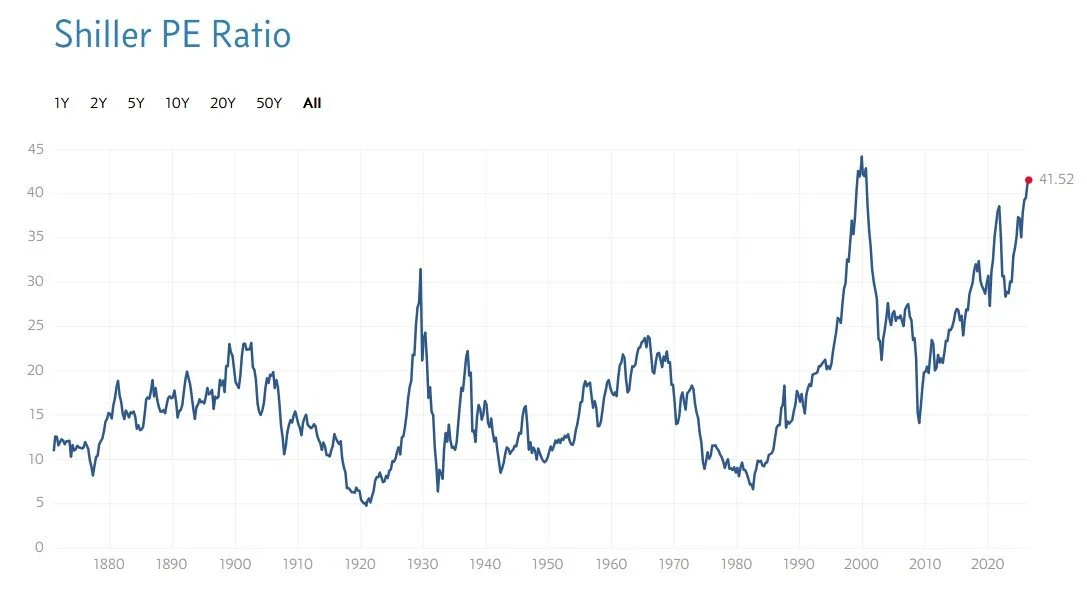
Chart: Multpl, “Shiller PE Ratio”
Annotation: Current: 41.52 | Historical mean: 17.39 | December 1999 maximum: 44.19
Chart date: July 17, 2026
The Shiller P/E, also known as CAPE, divides the current market price by average inflation-adjusted earnings over the preceding ten years. Averaging earnings across a full decade reduces the effect of temporary booms and recessions.
At 41.52, today’s reading is not merely above average. It is close to the highest level in the series, reached near the culmination of the late-1990s technology boom.
That comparison does not mean that today’s businesses, interest-rate environment, index composition, or profit margins are identical to those of 1999. They are not. Nor does it imply that a comparable decline must follow.
It does, however, suggest that a substantial amount of future success is already reflected in current prices.
Our interpretation is that investors should expect less help from further valuation expansion. Future returns may need to be earned primarily through actual growth in revenues, cash flows, and earnings. Should those fundamentals disappoint, there is less valuation support beneath the market.
Different measures, a similar message
No single valuation measure should determine an investment decision. Each has methodological limitations.
The Buffett Indicator, for example, compares the total value of the U.S. stock market with U.S. gross domestic product. It can be affected by the international revenues of American companies, changing profit margins, the composition of the public markets, and the prevailing interest-rate environment.
Even after accounting for its long-term trend, however, Current Market Valuation’s March 31, 2026 model placed the ratio at 219%. That was approximately 2.1 standard deviations above the model’s historical trend and was classified by the site as “strongly overvalued.”
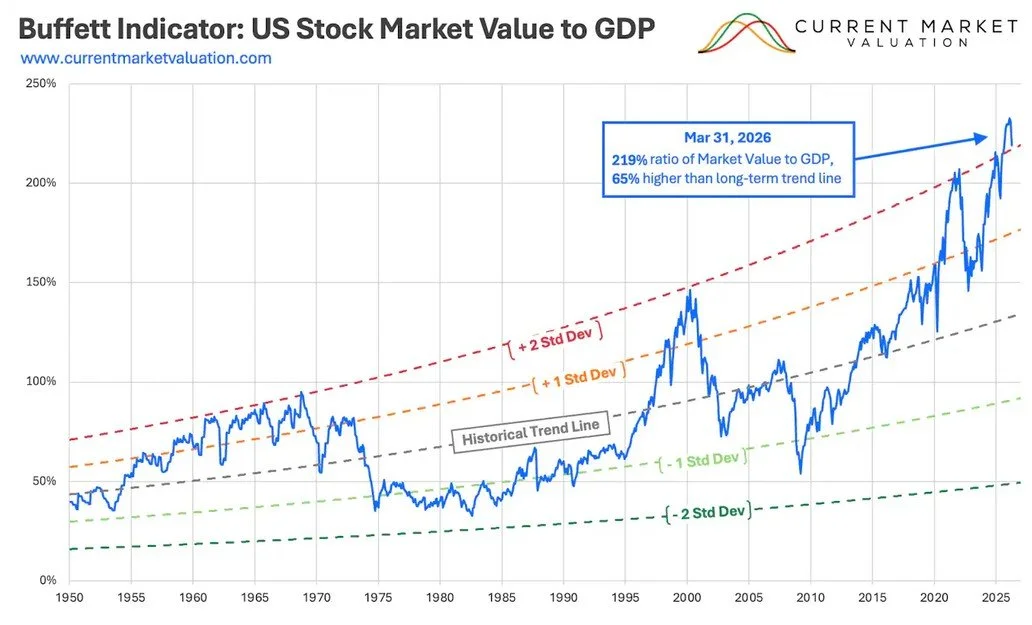
Suggested chart: Current Market Valuation, “Market Value to GDP Ratio with Standard Deviation Bands”
Annotation: 219% of annualized GDP | 2.1 standard deviations above trend
Chart date: March 31, 2026
A separate measure reaches a similar conclusion. Current Market Valuation reported an S&P 500 price-to-sales ratio of 3.0 as of March 31, compared with an average of approximately 1.8 since 2000. Its model placed that reading 2.1 standard deviations above normal.
The importance of this agreement is not that any one model is infallible. It is that several measures using different denominators—earnings, sales, and economic output—are pointing in broadly the same direction.
U.S. equities are priced for favorable outcomes.
There are also counterpoints. Current Market Valuation’s earnings-yield-gap model classified equities as fairly valued relative to Treasury bonds as of March 31. Its junk-bond-spread and volatility models were also within their respective neutral ranges. Not every indicator is signaling speculative excess, and that is one reason we do not view the current environment as a simple all-in or all-out decision.
Leverage changes the character of a decline
High valuation describes the price investors are willing to pay. Margin debt tells us something about how some of those purchases are being financed.
Margin borrowing allows investors to purchase securities with money borrowed from their brokerage firms. It can increase gains while markets rise, but it also magnifies losses when they fall.
Current Market Valuation’s February 2026 margin model reported $1.253 trillion of U.S. margin debt, an increase of $313 billion from the preceding year. After adjusting the increase for the growth of the overall stock market, its model placed the change approximately 1.12 standard deviations above its historical average.
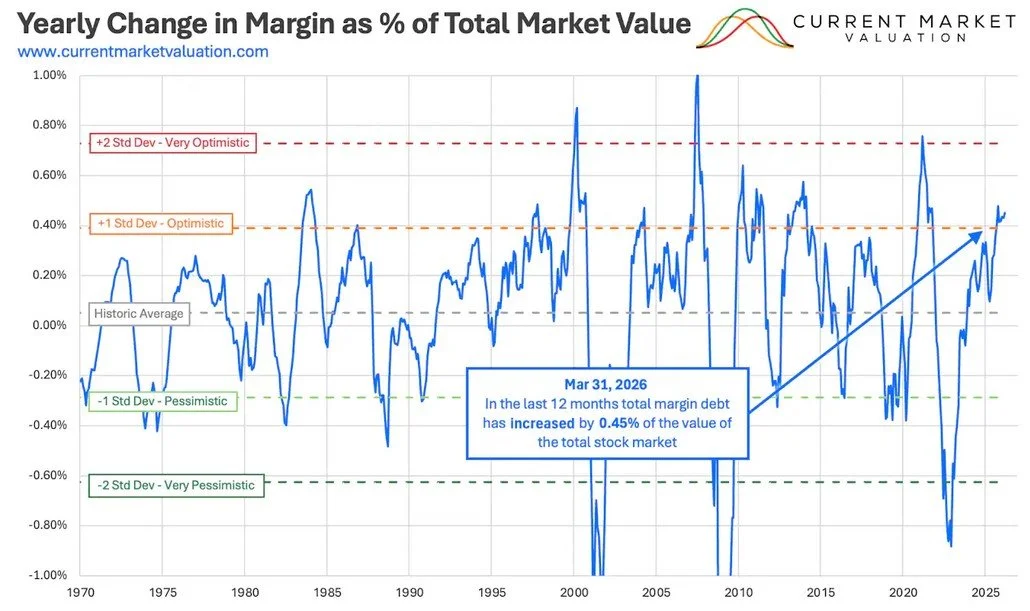
Suggested chart: Current Market Valuation, “Yearly Change in Margin Debt as a Percentage of Equity Market Size”
Primary caption: The level of margin debt naturally rises as the market grows. The rate of change relative to total market value is the more informative risk measure.
Chart date: February 28, 2026
The public Current Market Valuation chart is dated February, but the subsequent FINRA data show that the absolute amount of margin borrowing continued to rise. By June, customer margin debit balances had reached $1.502 trillion—approximately 20% above February and 49% above June 2025.
This does not prove that investors are about to sell. Leverage can continue increasing as long as markets remain favorable.
The concern is what happens after prices begin to decline.
When account equity falls below a broker’s maintenance requirement, the investor may need to contribute cash or sell securities. Brokerage firms may also raise their own margin requirements and, in some circumstances, liquidate positions without allowing the customer to select what is sold. Leverage can therefore transform a discretionary seller into a forced seller.
That distinction matters. A market populated primarily by unleveraged, long-term owners can absorb volatility differently from one in which a growing share of exposure is financed and subject to collateral requirements.
The issue is not simply that investors are optimistic. It is that some of the optimism is borrowed.
A cooling economy meets elevated expectations
High valuations are easiest to sustain when economic growth and corporate earnings continue to surprise positively. The current economic data are not uniformly weak, but the margin for disappointment appears to be increasing.
Employment
The labor market remains functional, but the pace of hiring has moderated. Payroll employment increased by 57,000 in June, while the average monthly increase during the preceding twelve months was only 36,000. The unemployment rate was 4.2%, and the number of long-term unemployed was 286,000 higher than one year earlier. Labor-force participation declined to 61.5% in June.
There are countervailing signs of resilience. Unemployment remains relatively contained, job openings totaled 7.6 million in May, and layoffs were not accelerating dramatically in the latest Job Openings and Labor Turnover report.
We would characterize this as a labor market that is cooling rather than collapsing.
Housing
Housing is sending a comparable message.
The FHFA national house-price index declined 0.1% in April, its latest monthly reading, although prices remained 2.0% above April 2025. For the first quarter as a whole, national prices were 1.7% higher than a year earlier, but eight states and the District of Columbia recorded annual declines. Prices also fell in 35 of the 100 largest metropolitan markets.
National appreciation has not disappeared. It has become slower and more geographically uneven.
That matters because housing is more than an asset price. It influences household confidence, construction activity, geographic mobility, credit creation, and consumers’ perception of their own balance sheets. A gradual normalization would be manageable. A more abrupt decline could affect spending and employment at a time when equity valuations already assume strong corporate performance.
Mixed recession signals
Current Market Valuation’s own economic models illustrate the ambiguity. Its March Leading Economic Index model showed the index at 97.30, below its twelve-month moving average of 98.27, and classified near-term recession risk as high. At the same time, its unemployment-based Sahm Rule model continued to show normal recession risk.
Economic conditions do not move in a straight line, and indicators frequently disagree around turning points. We therefore do not believe the evidence supports declaring that a recession is inevitable.
But the combination of slowing activity and elevated asset prices deserves attention. A recession is not required for earnings expectations to decline, valuation multiples to contract, or equity markets to experience a meaningful correction.
Preparation is different from prediction
The practical response to these conditions is not to build a portfolio around a single forecast.
It is to reduce the number of favorable assumptions the portfolio requires.
For investors, that begins with several questions:
Has recent appreciation pushed equity exposure above its intended policy range?
Are near-term spending needs, taxes, capital calls, or business commitments insulated from a market decline?
Is leverage present directly through margin loans, or indirectly through concentrated positions and illiquid commitments?
Does the portfolio contain investments driven by meaningfully different sources of return, or merely different labels attached to the same equity-market risk?
Rebalancing an overweight position is not a prediction that the asset will fall. It is the enforcement of a previously established discipline.
Maintaining liquidity is not an assertion that a downturn is imminent. It is a way to avoid selling long-term assets during an unfavorable market.
Diversification is not an attempt to eliminate volatility. It is an effort to prevent one economic outcome from determining the success or failure of an entire financial plan.
And avoiding unnecessary leverage is not excessively conservative. It preserves the investor’s ability to make decisions rather than having those decisions imposed by a lender.
What we are watching
In the coming quarter, we will be paying particular attention to three developments.
Earnings breadth. Can earnings growth extend beyond the relatively small group of companies currently carrying much of the market’s expectations?
Labor-market deterioration. Does slower hiring remain orderly, or does it begin to appear in unemployment claims, permanent job losses, and reduced household income?
Housing dispersion. Do price declines remain concentrated in selected regions, or do they broaden into a national contraction?
None of these indicators provides a perfect trading signal. Together, however, they can tell us whether the economy and corporate fundamentals are continuing to justify current valuations.
A narrower margin for error
Valuations may remain elevated. Corporate earnings may continue to grow. Housing and employment may stabilize without a recession. Margin borrowing may rise further before it becomes a source of instability.
We should acknowledge all of those possibilities.
But a sound financial plan should not require all of them to occur.
The central question is not whether a market correction is “due.” It is whether the portfolio remains appropriate if future returns are lower, volatility is higher, or access to liquidity becomes more valuable.
At Analog Capital Partners, our objective is not to predict every turn in the market. It is to help clients remain in control of their decisions across a range of possible outcomes.
Discipline matters most when it appears least necessary.
Analog Capital Partners
Should You Get a Second Opinion on Your Investment Portfolio?
By Analog Capital Partners
Most people would not hesitate to seek a second opinion before making a major medical decision.
They might consult another specialist.
Review the diagnosis.
Compare treatment options.
Ask whether the original recommendation still makes sense.
Not because they distrust their doctor.
Because the decision matters.
We believe major financial decisions deserve the same level of care.
An investment portfolio may influence when you retire, how much you can spend, the taxes you pay, the risks your family carries, and the legacy you eventually leave behind.
Yet many investors go years—sometimes decades—without asking an independent professional to review whether their strategy still fits their life.
That is understandable.
Financial relationships are often personal.
Your advisor may know your family. They may have worked with you through several market cycles. You may feel loyal to the person or firm that helped you get started.
A second opinion does not require abandoning that relationship.
It does not mean your current advisor has failed.
And it does not mean changes are necessary.
It simply means asking a reasonable question:
Does my portfolio still make sense for the life I am trying to build?
Sometimes the answer is yes.
Sometimes the answer is mostly.
Sometimes a second opinion reveals risks, costs, tax issues, or structural weaknesses that have gone unnoticed.
In every case, greater clarity is valuable.
What Is an Investment Portfolio Second Opinion?
A portfolio second opinion is an independent review of your current investment strategy.
The purpose is not to predict which stock will outperform next year.
It is not to criticize every decision your current advisor has made.
And it should not be disguised as a sales presentation.
A thoughtful second opinion examines whether the portfolio is aligned with your goals, financial plan, tax situation, risk tolerance, time horizon, and broader wealth strategy.
That review may include:
Asset allocation
Diversification
Investment costs
Tax efficiency
Concentration risk
Liquidity
Income needs
Withdrawal strategy
Rebalancing discipline
Risk exposure
Estate-planning considerations
The role of alternative investments
Coordination with retirement and cash-flow planning
The most useful outcome is not necessarily a list of changes.
It is a clearer understanding of what you own, why you own it, what could go wrong, and whether the portfolio is designed to support your objectives.
Why Investors Rarely Seek a Second Opinion
Most investors do not avoid second opinions because they are satisfied with every aspect of their portfolio.
They avoid them because changing—or even questioning—a financial relationship can feel uncomfortable.
Several common concerns tend to surface.
“I Do Not Want to Offend My Advisor”
A professional advisor should understand that clients have a responsibility to evaluate important decisions carefully.
Seeking another perspective is not an accusation.
It is due diligence.
Good advice should withstand scrutiny.
If a portfolio is well designed, an independent review may reinforce the original strategy and give you greater confidence.
If your advisor becomes defensive simply because you ask questions, that reaction may tell you something important.
“I Would Not Know What to Ask”
That is one reason second opinions can be useful.
Many investors know something feels unclear, but they are not sure how to evaluate the portfolio.
They may wonder:
Am I taking too much risk?
Are my fees reasonable?
Why do I own so many funds?
Is my portfolio tax efficient?
Am I properly diversified?
Will this strategy support retirement income?
Is my advisor acting as a fiduciary?
Should my portfolio have changed as my life changed?
A good reviewer helps translate vague concerns into specific questions.
“My Portfolio Has Performed Well”
Strong recent performance can create a false sense of certainty.
A portfolio may perform well because markets have been favorable, because one concentrated position rose significantly, or because the strategy took more risk than the investor realized.
Performance matters.
But performance alone does not tell you whether a portfolio is well constructed.
The more useful questions are:
How much risk was required to earn that return?
How diversified is the strategy?
What happens under different market conditions?
Is the portfolio tax efficient?
Is the current level of risk appropriate for my goals?
A strategy should not be evaluated only when it is struggling.
Periods of strong performance may be the ideal time to review concentration, rebalance risk, and make decisions without emotional pressure.
“Nothing Major Has Changed”
Often, more has changed than investors realize.
Your income may be different.
Your business may be worth more.
Retirement may be closer.
Your tax bracket may have changed.
Your children may be older.
Your estate plan may be outdated.
Your willingness to tolerate losses may have declined.
The portfolio may still reflect the person you were ten years ago rather than the life you have today.
A second opinion can help identify that gap.
When Should You Consider a Second Opinion?
There is no single trigger.
But certain events make an independent review especially valuable.
1. You Are Approaching Retirement
Retirement changes the job of a portfolio.
During your working years, the primary goal may be accumulation.
In retirement, the portfolio may need to provide income, manage taxes, preserve liquidity, and withstand withdrawals during difficult markets.
That transition introduces new risks.
A portfolio that was reasonable while you were earning a salary may not be appropriate once you begin drawing from it.
Questions become more complex:
How much can I withdraw?
Which accounts should I draw from first?
How much cash should I hold?
How should bonds, stocks, and other assets be structured?
What happens if markets decline early in retirement?
Should I complete Roth conversions?
How will required minimum distributions affect taxes later?
How should Social Security and pension income fit into the plan?
A second opinion can test whether the investment strategy and retirement-income plan actually work together.
2. You Recently Sold a Business
Selling a business may create the largest financial transition of an entrepreneur’s life.
Before the sale, much of the owner’s wealth may have been concentrated in one company.
After the sale, the challenge shifts.
The owner may suddenly need to invest a large pool of liquid capital, replace business income, manage a major tax event, and redefine the purpose of the family’s wealth.
That is not simply an investment decision.
It is a planning decision involving:
Taxes
Estate strategy
Liquidity
Charitable giving
Risk tolerance
Family governance
Long-term income needs
A second opinion can help determine whether the proposed investment strategy reflects the scale and complexity of the transition.
3. You Received an Inheritance
An inheritance often arrives during an emotional period.
It may also bring unfamiliar assets, concentrated stock, real estate, retirement accounts, or tax consequences.
The natural impulse is often to act quickly.
Usually, there is value in slowing down.
A second opinion can help answer:
Which assets should be retained?
Which should be sold?
What taxes may apply?
How should inherited accounts be handled?
Does the inheritance change retirement timing?
Should part of the wealth be used for education, philanthropy, or debt reduction?
How should the new assets be integrated with the existing portfolio?
The objective is not simply to invest the inheritance.
It is to incorporate it thoughtfully into your life.
4. You Changed Jobs or Received Significant Equity Compensation
Executives often accumulate wealth through restricted stock, stock options, deferred compensation, and employee stock-purchase plans.
Those assets can create substantial opportunity.
They can also create concentration risk.
Your salary, bonus, career prospects, and investment portfolio may all depend on the same company.
That relationship is easy to overlook when the stock has performed well.
A second opinion can evaluate:
How concentrated your wealth has become
Whether a diversification plan is needed
The tax implications of selling
Option-exercise timing
Vesting schedules
Trading restrictions
Liquidity needs
The interaction between company stock and the rest of the portfolio
The goal is not necessarily to sell everything.
It is to make the concentration intentional rather than accidental.
5. You Are Paying More Than You Understand
Many investors know their advisor’s headline fee.
Far fewer know their total cost.
A portfolio may also include:
Mutual-fund expenses
Insurance charges
Annuity expenses
Trading costs
Custodial fees
Performance fees
Sales loads
Embedded product expenses
Alternative-investment fees
No fee is inherently unreasonable.
The question is whether the cost is transparent and justified by the value received.
A second opinion can help calculate the complete economic picture.
It can also determine whether complexity is serving a purpose—or simply creating additional expense.
6. Your Portfolio Feels More Complicated Than It Should
Complexity can look like sophistication.
The two are not the same.
Some investors own dozens of mutual funds, exchange-traded funds, private investments, insurance products, structured notes, and legacy accounts spread across multiple institutions.
The result may be difficult to understand and even harder to manage.
A complicated portfolio may contain:
Significant overlap
Hidden concentration
Conflicting strategies
Redundant holdings
Unnecessary tax consequences
Higher costs
Liquidity restrictions
No clear rebalancing process
Every holding should have a role.
If no one can explain that role clearly, complexity may be obscuring rather than improving the strategy.
7. Your Portfolio Was Built Around Predictions
Some portfolios are built around a durable philosophy.
Others are assembled one forecast at a time.
One year, the strategy emphasizes inflation.
The next year, recession.
Then artificial intelligence.
Then interest-rate cuts.
Then geopolitical risk.
The portfolio becomes a collection of responses to headlines rather than a coherent system.
Markets will always provide a persuasive reason to make another change.
The challenge is distinguishing between thoughtful adaptation and constant reaction.
A second opinion can help determine whether your portfolio has a stable foundation or depends on repeatedly being right about an uncertain future.
8. You Have Experienced a Major Life Change
Divorce.
Marriage.
The birth of a child.
The death of a spouse.
A significant health event.
Relocation.
The purchase or sale of real estate.
A change in family responsibility.
These events affect more than your financial plan.
They can change liquidity needs, risk capacity, beneficiary designations, estate documents, insurance requirements, and investment priorities.
A portfolio should evolve with the investor.
When life changes, the strategy deserves another look.
9. Communication With Your Advisor Has Declined
A portfolio can be technically sound and still leave the client poorly served.
Communication matters.
Consider a second opinion when:
You rarely hear from your advisor
Meetings feel reactive rather than proactive
Questions take too long to answer
You do not know who is responsible for your relationship
Your advisor cannot explain the portfolio clearly
Recommendations arrive without context
You feel uncomfortable asking basic questions
Wealth management is not only about what you own.
It is also about whether you understand the strategy and trust the process.
10. You Simply Want Confirmation
Not every second opinion begins with a problem.
Sometimes the question is:
Are we still on the right track?
That is a perfectly reasonable reason to seek another perspective.
A well-constructed portfolio may require no major changes.
Confirmation can prevent unnecessary action, reduce anxiety, and provide confidence during difficult markets.
“No change recommended” can be a valuable conclusion.
What Should a Portfolio Review Examine?
A credible second opinion should move beyond surface-level performance.
It should examine the structure beneath the returns.
Asset Allocation
Asset allocation describes how the portfolio is divided among stocks, bonds, cash, real assets, and other investments.
It is one of the primary drivers of portfolio behavior.
The review should ask:
Is the allocation appropriate for the investor’s goals?
Is the portfolio positioned for accumulation or distribution?
Does the level of risk match the financial plan?
Are the assumptions realistic?
Is the allocation intentional or simply the result of market movements over time?
A portfolio can drift significantly if it is not reviewed and rebalanced.
Diversification
Diversification is not measured by the number of holdings.
A portfolio can own many investments and still be concentrated.
For example, several funds may hold the same large companies. Multiple strategies may depend on the same economic outcome. Private investments may create hidden exposure to one industry or region.
A proper review looks through the labels and asks:
What are the true economic exposures?
How much overlap exists?
What risks are shared across holdings?
How might the portfolio behave in different environments?
The objective is not to diversify for its own sake.
It is to avoid relying too heavily on one company, sector, asset class, manager, or forecast.
Risk
Risk questionnaires can be useful.
They are not enough.
Real risk depends on more than how an investor says they might feel during a market decline.
A second opinion should consider:
Time horizon
Spending needs
Job stability
Business ownership
Concentrated equity
Liquidity
Debt
Retirement timing
Tax exposure
Emotional tolerance for losses
There is a difference between the amount of risk an investor is willing to take and the amount of risk they can afford to take.
There is also a third question:
How much risk do they actually need to take?
Many investors assume more risk is always necessary.
Sometimes the financial plan says otherwise.
Fees and Expenses
The review should identify all visible and embedded costs.
That includes the advisory fee as well as the expenses inside the portfolio.
The purpose is not to minimize every fee.
Low cost is not the same as high value.
The purpose is to determine whether:
Costs are fully understood
Fees are competitive
The services justify the price
Less expensive alternatives exist
Complexity is adding value
Compensation creates conflicts
Investors should know what they are paying and what they receive in return.
Tax Efficiency
Two portfolios with identical pre-tax returns can produce different outcomes after taxes.
A second opinion should examine:
Asset location
Turnover
Realized gains
Tax-loss harvesting
Municipal-bond use
Charitable-giving opportunities
Withdrawal sequencing
Roth-conversion strategy
Concentrated low-basis positions
Coordination across taxable and retirement accounts
Tax planning should not be limited to year-end.
It should influence decisions throughout the year.
Liquidity
Not all wealth is equally accessible.
Private investments, real estate, annuities, restricted stock, and certain alternative strategies may limit access to capital.
A portfolio can appear valuable on paper while leaving the investor with insufficient liquidity.
The review should ask:
How much cash is available?
What near-term obligations exist?
Which assets can be sold quickly?
What penalties or tax consequences may apply?
Are too many assets locked up at the same time?
Liquidity is often most valuable when markets are under stress.
That is precisely when it is easiest to underestimate.
Retirement-Income Sustainability
For retirees, the portfolio must do more than grow.
It must support withdrawals.
A second opinion should test:
Spending assumptions
Inflation
Sequence-of-returns risk
Longevity
Social Security
Pension income
Required minimum distributions
Tax brackets
Healthcare costs
Legacy goals
A retirement strategy should be evaluated under favorable and unfavorable conditions.
The purpose is not to predict the future.
It is to understand how much flexibility the plan has when the future differs from expectations.
What a Second Opinion Should Not Be
Not every portfolio review is objective.
Some are simply sales meetings with a more reassuring name.
A useful second opinion should not begin with a predetermined conclusion.
Be cautious when the reviewing advisor:
Criticizes the portfolio before understanding your goals
Focuses only on recent performance
Promises better returns
Uses fear to create urgency
Recommends replacing everything immediately
Pushes proprietary products
Avoids discussing fees
Presents complexity as proof of expertise
Dismisses your current advisor personally
Treats the review as a contest rather than an analysis
The goal should not be to prove that the existing portfolio is wrong.
The goal should be to determine whether it is appropriate.
Questions to Ask During a Second-Opinion Meeting
A productive review should leave you with better answers.
Consider asking:
1. What is the portfolio designed to accomplish?
Every strategy should have a clear purpose.
2. What are the largest risks?
The reviewer should identify both obvious and hidden risks.
3. Am I more concentrated than I realize?
This is especially important for executives, entrepreneurs, and investors with legacy holdings.
4. What am I paying in total?
Ask for both advisory and underlying investment costs.
5. Is the portfolio tax efficient?
The answer should address more than tax-loss harvesting.
6. How might the portfolio behave during a major decline?
No one knows exactly, but reasonable stress testing can reveal important vulnerabilities.
7. Which holdings appear redundant?
Overlap can add cost without adding diversification.
8. What would you change first—and why?
Priorities matter.
9. What would you leave unchanged?
A balanced reviewer should be willing to acknowledge what is working.
10. How does the portfolio connect to my financial plan?
Investments should support the plan, not exist separately from it.
What Outcomes Can Come From a Second Opinion?
There are several possible conclusions.
The Portfolio Is Appropriate
This is a good outcome.
The review may confirm that the allocation, diversification, cost, and tax structure remain reasonable.
That reassurance can be especially valuable before retirement or during volatile markets.
Minor Adjustments Are Needed
The portfolio may be broadly sound but benefit from:
Rebalancing
Tax improvements
Fee reduction
Simplification
Better asset location
Reduced concentration
Increased liquidity
Not every review should result in a complete overhaul.
The Strategy Needs Significant Work
Sometimes the portfolio no longer reflects the investor’s life.
Perhaps risk is excessive.
Costs are difficult to justify.
The strategy is concentrated.
The tax structure is inefficient.
Or the portfolio was assembled without a clear financial plan.
In those cases, a more substantial redesign may be appropriate.
The Advisor Relationship Needs Review
The investments may not be the primary issue.
The larger concern may involve communication, transparency, service, or incentives.
A second opinion can help separate portfolio problems from relationship problems.
That distinction matters.
Should You Tell Your Current Advisor?
You can.
You do not have to.
Some investors prefer to speak openly with their advisor before seeking another review.
Others want an independent perspective first.
There is no universal rule.
What matters is that you feel free to evaluate the relationship without pressure.
After the review, you may decide to bring specific questions back to your current advisor.
Their answers—and their willingness to engage—may be as informative as the portfolio analysis itself.
How Often Should You Get a Second Opinion?
A second opinion is not something most investors need every year.
But periodic independent review can be sensible, particularly after major transitions.
Consider one when:
Retirement is within several years
A business or property is sold
You receive an inheritance
Your wealth increases substantially
Your advisor or firm changes
Your portfolio becomes more complex
You experience a major life event
You no longer understand the strategy
You have not had a comprehensive review in many years
The purpose is not to create constant doubt.
It is to prevent complacency.
The Analog Capital Partners Perspective
At Analog Capital Partners, we believe a portfolio should be understandable.
You should know what you own.
You should know why you own it.
You should understand the risks.
You should know what you are paying.
And you should be able to see how the strategy connects to your financial life.
Our second-opinion process is designed to provide clarity.
We review the portfolio through the lens of:
Goals
Risk
Diversification
Costs
Taxes
Liquidity
Retirement income
Long-term resilience
We do not believe every portfolio needs to be replaced.
We do not believe the answer to every concern is more complexity.
And we do not believe successful investing depends on predicting what markets will do next.
Sometimes the right recommendation is a meaningful change.
Sometimes it is a small adjustment.
Sometimes it is confirmation that the current strategy remains appropriate.
The conclusion should follow the evidence.
Not the other way around.
The Bottom Line
You do not need to be dissatisfied with your advisor to seek a second opinion.
You do not need to wait for poor performance.
You do not need to prove that something is wrong.
You only need to believe the decision is important enough to review carefully.
A second opinion can identify unnecessary risk.
It can reveal hidden costs.
It can improve tax efficiency.
It can simplify a complicated portfolio.
It can test whether your retirement strategy is durable.
Or it can confirm that you are already on the right track.
All of those outcomes have value.
The most important question is not:
“Did my portfolio outperform last year?”
It is:
“Is this strategy still appropriate for my goals, my risks, and the life I want to live?”
If you cannot answer that question confidently, it may be time for another perspective.
Frequently Asked Questions
What is included in an investment portfolio second opinion?
A second opinion may include a review of asset allocation, diversification, fees, taxes, risk, liquidity, concentration, retirement-income needs, and the connection between the portfolio and the broader financial plan.
Does getting a second opinion mean I need to change advisors?
No. The review may confirm that your current portfolio and advisor remain appropriate. You can also use the findings to have a more informed conversation with your existing advisor.
When is the best time to get a portfolio review?
Common times include before retirement, after selling a business, following an inheritance, after a major job change, during a significant life transition, or whenever you no longer understand or feel confident in the strategy.
Should I get a second opinion after poor investment performance?
You can, but performance should be evaluated in context. A poor short-term return does not necessarily mean the portfolio is inappropriate, just as strong performance does not necessarily mean it is well designed.
How can I tell whether my portfolio is too risky?
Risk should be evaluated in relation to your goals, spending needs, time horizon, income, liquidity, and emotional tolerance for losses. A second opinion can help determine whether the risk you are taking is both necessary and appropriate.
Can a second opinion help reduce investment fees?
It can identify advisory fees, fund expenses, product charges, and other costs. Whether fees should be reduced depends on the services provided and the value of the relationship.
Will the reviewing advisor need my account statements?
Usually, yes. A useful review generally requires recent statements, cost-basis information, fee disclosures, and an understanding of your goals and financial circumstances.
How long should a second-opinion review take?
The answer depends on the complexity of the portfolio. The quality of the review matters more than speed. A thoughtful analysis should allow enough time to understand both the investments and the investor.
Considering a Second Opinion?
Your portfolio should reflect more than the markets.
It should reflect your goals, taxes, spending needs, family responsibilities, and tolerance for uncertainty.
Analog Capital Partners provides independent portfolio reviews for individuals and families seeking greater clarity about their investment strategy.
A second opinion may lead to change.
It may also lead to confidence.
Both can be valuable.
Fee-Only vs. Fee-Based Financial Advisors: What’s the Difference?
By Analog Capital Partners
The financial-services industry has a language problem.
Two advisors can use nearly identical titles.
They can work in similar-looking offices.
They can discuss the same retirement goals, investment strategies, and financial-planning concepts.
They can even describe themselves using words like independent, fiduciary, or objective.
Yet they may be compensated in fundamentally different ways.
That difference matters.
One advisor may be paid exclusively by clients.
Another may receive client fees while also earning commissions or other compensation connected to financial products.
The distinction is often summarized using two terms:
Fee-only.
Fee-based.
They sound almost identical.
They are not.
Understanding the difference will not tell you everything you need to know about a financial advisor. Compensation is only one part of evaluating a firm’s expertise, investment philosophy, service model, and culture.
But it is an important place to begin.
How an advisor is paid can influence which products are available, which recommendations are emphasized, and which conflicts must be managed or disclosed.
The goal of this article is not to suggest that every commission creates bad advice or that every fee-only advisor provides excellent advice.
Neither statement is true.
The goal is to give investors enough clarity to ask better questions.
Because when someone helps guide your retirement, investments, taxes, estate strategy, or family wealth, you deserve to understand exactly who is paying them—and why.
What Is a Fee-Only Financial Advisor?
A fee-only financial advisor is compensated directly by clients.
The advisor and firm do not receive sales-related compensation for recommending or selling financial products.
Depending on the firm, clients may pay through:
A percentage of assets under management
A flat annual or quarterly retainer
An hourly planning fee
A fixed project fee
A combination of client-paid fees
The defining feature is not the specific billing method.
It is the source of compensation.
Under the fee-only model, the client pays the advisor for advice, financial planning, and investment management.
The advisor does not receive commissions, referral payments, sales loads, or similar compensation tied to the purchase or sale of financial products.
The National Association of Personal Financial Advisors defines fee-only advisors as professionals compensated solely by clients, with neither the advisor nor a related party receiving compensation contingent on the purchase or sale of a financial product.
CFP Board also applies a specific definition. Under its standards, a CFP® professional may describe their compensation as fee-only only when the professional and the professional’s firm receive no sales-related compensation.
In plain English:
A fee-only advisor is paid by the client—not by the product.
That does not remove every possible conflict.
No compensation system can.
But it can remove a significant category of conflict: the incentive to recommend one product because it pays the advisor more than another.
What Is a Fee-Based Financial Advisor?
A fee-based financial advisor may receive both:
Fees paid directly by clients, and
Sales-related compensation, such as commissions.
For example, a fee-based advisor might charge an annual advisory fee for managing a portfolio while also earning a commission from the sale of an insurance policy, annuity, mutual fund, or another financial product.
CFP Board uses the term “fee and commission” for professionals who receive both fees and sales-related compensation. Its guidance says that the term fee-based should not be used in a way that suggests the professional or firm is fee-only.
This distinction is easy to miss because fee-based sounds like a description of an advisor who charges fees.
And it is.
But it may not be the only way the advisor is compensated.
That is the critical point.
A fee-based advisor may be paid by the client and by third parties connected to the products being recommended.
Why Do the Terms Sound So Similar?
Because they developed inside an industry that is not known for making compensation simple.
To a prospective client, the words fee-only and fee-based may appear almost interchangeable.
The difference between them is only one word.
But that word can represent an entirely different economic relationship.
Consider two hypothetical advisors.
Advisor A: Fee-Only
Advisor A charges a client 0.80% annually to manage investments and provide ongoing financial planning.
The firm does not accept commissions.
The advisor’s compensation does not change based on which mutual fund, exchange-traded fund, custodian, insurance policy, or outside professional the client ultimately uses.
Advisor B: Fee-Based
Advisor B charges a 0.80% annual advisory fee.
The advisor is also licensed to sell certain financial products and may receive additional compensation when clients purchase them.
Both advisors charge a fee.
Only one is fee-only.
That difference does not automatically determine which advisor is more competent or whether a particular recommendation is appropriate.
It does tell you that the two advisors may face different incentives.
And incentives deserve scrutiny.
Is Fee-Only the Same as Fiduciary?
Not exactly.
The terms describe different things.
Fee-only describes compensation.
Fiduciary describes a standard of conduct.
A fiduciary is required to act in the client’s best interest under the circumstances in which the fiduciary duty applies.
Investment advisers are subject to a fiduciary standard under the Investment Advisers Act, while broker-dealers are subject to Regulation Best Interest when making covered recommendations to retail customers. SEC guidance explains that both standards are built around the principle that a financial professional should not place their interests ahead of the retail investor’s interests, although the standards can apply differently depending on the relationship and circumstances.
Compensation and fiduciary status often overlap, but they are not identical.
A fee-only advisor may operate as a fiduciary.
A fee-based professional may also act as a fiduciary when providing certain advisory services.
A CFP® professional, regardless of compensation model, commits under CFP Board’s standards to act as a fiduciary when providing financial advice.
That is why asking only one question is rarely enough.
Do not stop with:
“Are you a fiduciary?”
Also ask:
“Are you acting as a fiduciary throughout our entire relationship?”
And:
“Can you or your firm receive commissions or other compensation related to the recommendations you make?”
The answers together provide far more clarity than either answer alone.
Does Fee-Only Mean Conflict-Free?
No.
It is more accurate to say that the fee-only model can reduce certain conflicts.
It does not eliminate all of them.
That distinction matters.
Suppose an advisor charges a percentage of the assets they manage.
That model may remove product commissions, but it can still create other incentives.
For example:
The advisor may have an incentive to encourage a client to keep more money under management.
The advisor may be economically discouraged from recommending that a client use portfolio assets to pay down a mortgage.
The advisor may prefer managing an investment account over recommending an outside strategy that reduces managed assets.
Larger accounts may generate more revenue even when the service requirements are similar.
None of those possibilities means an asset-based fee is inappropriate.
It means every compensation structure has tradeoffs.
An hourly advisor may have an incentive to bill more hours.
A flat-fee advisor may have an incentive to limit the time spent on a relationship.
A commission-based professional may have an incentive to recommend products that create compensation.
A fee-only asset manager may have an incentive to retain or gather assets.
Conflicts cannot always be avoided.
But they can be identified, disclosed, minimized, and managed.
The better question is not:
“Does this advisor have any conflicts?”
Every advisor does.
The better questions are:
“What are the conflicts?”
“How are they managed?”
“Can you explain them clearly?”
“Would your compensation change if I followed a different recommendation?”
Are Commissions Always Bad?
No.
A commission is a method of compensation.
It is not, by itself, proof of misconduct or poor advice.
There are circumstances in which a client may prefer a transactional arrangement.
For example, someone who needs a single brokerage transaction and does not require ongoing planning may reasonably prefer to pay a commission rather than an annual advisory fee.
FINRA notes that brokerage accounts commonly use transaction-based compensation, such as commissions or markups, while advisory accounts often charge ongoing fees. The better arrangement depends partly on how frequently a client expects to trade and what level of ongoing service is needed.
The problem arises when compensation is unclear.
A client may believe the advice is free when the advisor is actually compensated through a product.
A client may not realize that one investment pays the advisor more than another.
Or a recommendation may be presented as objective without adequately explaining the financial incentives involved.
The issue is not that compensation exists.
Advisors should be paid for their work.
The issue is whether the compensation is transparent and aligned with the relationship the client believes they are entering.
How Fee-Based Compensation Can Create Additional Conflicts
Imagine that two products could reasonably address the same client need.
Product A pays the advisor no commission.
Product B pays the advisor several thousand dollars.
Even when both products are technically appropriate, the advisor has an economic incentive connected to the recommendation.
That incentive does not prove the recommendation is wrong.
It does create a conflict that should be understood.
Potential sales-related compensation may include:
Upfront commissions
Ongoing trailing commissions
Mutual-fund sales loads
Insurance commissions
Annuity commissions
Revenue-sharing payments
Referral fees
Incentive awards
Compensation linked to production targets
Certain investment products may also carry internal expenses or sales charges that are not immediately visible from the advisor’s stated planning or management fee.
FINRA advises investors to consider both account-level fees and product-level costs because investment expenses can vary based on the account, service, and products used.
This is why an advisor’s headline fee does not always tell you the full cost.
A client may pay:
The advisor’s fee
The underlying fund expenses
Custodial or administrative charges
Trading costs
Sales loads
Insurance or annuity expenses
Other product-specific charges
The most useful question is not simply:
“What is your fee?”
Ask instead:
“What is my total cost, including your compensation, product expenses, custody, trading, and any other charges?”
How Fee-Only Advisors Get Paid
Fee-only firms do not all use the same pricing structure.
Here are the most common arrangements.
Assets Under Management
The advisor charges a percentage of the assets the firm manages.
For example, a client may pay 1.00% annually on a portfolio, often with lower percentage rates at higher asset levels.
This model can provide ongoing access to planning and investment management.
It is also important to understand exactly which services are included.
Flat Retainer
The client pays a fixed quarterly or annual fee.
The fee may be based on the complexity of the household’s financial situation rather than the amount of money invested.
This model can be useful for clients whose planning needs are substantial but whose assets may not all be managed by the advisor.
Hourly Fee
The client pays for the advisor’s time.
This can work well for focused questions or limited planning engagements.
The relationship may be less comprehensive or less ongoing than a traditional wealth-management arrangement.
Project Fee
The advisor charges a fixed amount for a defined project, such as:
Building a financial plan
Reviewing a retirement strategy
Analyzing equity compensation
Evaluating an existing portfolio
Conducting a second opinion
Hybrid Client-Paid Structure
Some fee-only firms combine methods.
For example, they may charge an asset-based management fee plus a separate planning fee for particularly complex work.
The firm can still be fee-only as long as compensation comes from clients rather than product sales or third-party incentives.
Fee-Only Does Not Automatically Mean Less Expensive
One common misconception is that fee-only advisors are always cheaper.
They are not.
A fee-only wealth-management relationship may cost more than a limited brokerage arrangement, especially when the advisor provides ongoing investment management, financial planning, tax coordination, estate-planning support, and regular advice.
But price and value are not the same thing.
A transactional broker may charge less because the client is purchasing a narrower service.
A comprehensive advisor may charge more because the advisor is helping manage a much broader set of decisions.
The relevant question is not:
“Who has the lowest fee?”
It is:
“What am I receiving, what is the total cost, and is the value appropriate for my needs?”
The cheapest advisor can be expensive if the advice is poor.
The most expensive advisor can also be expensive if the service does not justify the cost.
Fees should be judged in context.
Fee-Based Does Not Automatically Mean Poor Advice
The opposite misconception is equally unhelpful.
Not every fee-based advisor provides conflicted or inferior advice.
Many highly experienced professionals work within firms that allow both advisory fees and commissions.
Some clients may need insurance or other products that are commonly sold on a commission basis.
The advisor may clearly disclose the compensation, evaluate reasonable alternatives, and make a sound recommendation.
The important issue is not the label alone.
It is whether the advisor can explain:
When they act in an advisory capacity
When they act in a brokerage or sales capacity
How the standard of conduct may differ
How they are compensated in each role
What conflicts accompany the recommendation
Whether comparable alternatives are available
Complexity is not automatically bad.
Hidden complexity is.
What Is a Dual-Registered Advisor?
Some financial professionals are associated with both:
A registered investment adviser, and
A broker-dealer
This arrangement is sometimes described as being dual-registered or dually licensed.
The professional may provide ongoing investment advice through an advisory relationship while also offering brokerage products through a separate capacity.
That creates an important question:
“Which hat are you wearing when you make this recommendation?”
The client may experience the relationship as continuous.
Legally and economically, however, the professional’s role may vary depending on the account, transaction, and service.
This is one reason investors should review the firm’s Form CRS, or Customer Relationship Summary.
The SEC requires registered broker-dealers and investment advisers serving retail investors to provide Form CRS, which is designed to help investors compare services, fees, conflicts, and standards of conduct.
Investors should also review an investment adviser’s Form ADV, particularly the firm brochure.
The SEC notes that Form ADV includes information about advisory services, compensation, fee schedules, business practices, conflicts of interest, and disciplinary history.
Do not treat these documents as paperwork to ignore.
They may tell you more about the firm than its marketing website does.
Questions to Ask Any Financial Advisor
You do not need to become an expert in financial regulation.
You do need to ask direct questions.
Here are ten worth asking.
1. Are you fee-only or fee-based?
Ask the advisor to define the term rather than simply repeating it.
2. Who compensates you?
The answer should include the client, the firm, product providers, insurance companies, referral arrangements, and any other relevant source.
3. Can you earn commissions?
Ask whether the advisor, the firm, an affiliate, or a related party can receive sales-related compensation.
4. Does your compensation change depending on what you recommend?
This is often more revealing than asking whether the advisor receives commissions.
5. Are you acting as a fiduciary at all times?
Ask whether the obligation applies throughout the relationship or only when the advisor performs certain services.
6. Do you sell insurance or investment products?
Selling a product is not inherently problematic. You should still understand how the professional gets paid.
7. What is my total cost?
Include advisory fees, product expenses, trading costs, custody, insurance charges, and other expenses.
8. Are there less expensive alternatives?
A thoughtful advisor should be able to discuss tradeoffs without becoming defensive.
9. Where can I review your disclosures?
Request the firm’s Form ADV, Form CRS, and any relevant product disclosures.
10. Will you put your compensation structure in writing?
Clarity should survive beyond the meeting.
Warning Signs to Watch For
Compensation conversations do not need to be adversarial.
But they should be specific.
Consider it a warning sign when an advisor:
Avoids answering how they are paid
Uses fee-based and fee-only interchangeably
Says the service is free without explaining product compensation
Focuses only on the advisory fee while ignoring underlying expenses
Refuses to discuss commissions
Cannot explain when they act as a fiduciary
Suggests that conflicts do not exist
Describes disclosure documents as unimportant formalities
Pressures you to purchase a product quickly
Becomes defensive when asked about incentives
A confident professional should welcome informed questions.
Your diligence is not an insult.
It is part of making a responsible decision.
Which Model Is Better?
There is no single compensation model that is perfect for every investor.
The appropriate arrangement depends on:
The complexity of your financial life
Whether you need ongoing advice
The type of products or services required
How frequently you expect to transact
The degree of planning involved
How much coordination you want among investments, taxes, estate planning, and retirement
Whether the advisor’s conflicts are understandable and manageable
That said, investors seeking comprehensive, ongoing wealth management often prefer a fee-only fiduciary because the structure can make compensation simpler to understand and reduce incentives connected to product sales.
But the label should never replace due diligence.
A fee-only advisor should still be able to demonstrate:
A disciplined investment philosophy
Appropriate credentials and experience
Transparent pricing
Thoughtful financial planning
Strong communication
A clear service model
A repeatable process
The ability to coordinate investments with taxes and estate planning
A culture that places clients first
Compensation tells you how the advisor gets paid.
It does not tell you how well the advisor will serve you.
The Analog Capital Partners Perspective
At Analog Capital Partners, we believe advice should be understandable.
That includes understanding the portfolio.
It includes understanding the planning process.
And it includes understanding how the advisor is compensated.
We operate as a fee-only fiduciary firm.
Our clients compensate us directly for investment management and wealth-management advice. We do not receive commissions for selling financial products.
We chose this structure for a simple reason:
We want the recommendations we make to be judged on whether they serve the client—not on whether a product generates additional compensation.
That does not mean conflicts disappear.
For example, an asset-based fee creates incentives that should be acknowledged and disclosed.
What it does mean is that our compensation does not change because we selected one fund, investment strategy, insurance product, or outside provider over another.
We believe that distinction creates greater clarity.
And clarity matters.
Financial advice is difficult enough without forcing clients to reverse-engineer the advisor’s incentives.
The Bottom Line
The difference between fee-only and fee-based is easy to summarize.
A fee-only advisor is compensated directly by clients and does not receive sales-related compensation for financial products.
A fee-based advisor may receive client fees and commissions or other sales-related compensation.
One word separates the labels.
A significant difference can separate the incentives.
But compensation should never be evaluated in isolation.
Ask whether the advisor acts as a fiduciary.
Understand which services are included.
Review the firm’s disclosures.
Calculate the total cost.
Evaluate the investment philosophy.
And pay attention to whether the advisor welcomes difficult questions.
The right advisor will not ask you to ignore conflicts.
They will help you understand them.
Because trust should not depend on how confidently someone speaks.
It should be built on transparency.
Frequently Asked Questions
What is the simplest difference between fee-only and fee-based?
Fee-only advisors receive compensation directly from clients. Fee-based advisors may receive both client-paid fees and sales-related compensation, such as commissions.
Can a fee-based advisor be a fiduciary?
Yes, in some circumstances. A professional may act as a fiduciary when providing advisory services while also receiving commissions through other parts of the business. Ask whether the fiduciary obligation applies throughout the entire relationship.
Can fee-only advisors receive commissions?
Under generally accepted industry definitions, no. CFP Board and NAPFA restrict the use of fee-only when the advisor, firm, or related parties receive sales-related compensation.
How can I confirm how an advisor is paid?
Ask the advisor directly and review Form CRS and Form ADV. Those disclosures can provide information about services, fees, compensation, conflicts, and disciplinary history.
Is an assets-under-management fee considered fee-only?
It can be. An advisor may be fee-only while charging a percentage of managed assets, provided the advisor and firm do not receive sales-related compensation.
Is fee-only always cheaper?
No. The cost depends on the fee schedule and services included. A comprehensive fee-only relationship may cost more than a limited transactional relationship while providing a broader scope of advice.
Do commissions always create bad advice?
No. They create an economic incentive that should be disclosed and evaluated. The existence of a commission does not, by itself, prove that a recommendation is inappropriate.
Why does Analog Capital Partners use a fee-only model?
We believe client-paid compensation provides greater clarity and reduces conflicts associated with selling financial products. Our compensation does not change based on which investment or product we recommend.
Considering a Financial Advisor?
Before choosing an advisor, ask how the firm is compensated, when it acts as a fiduciary, what conflicts exist, and what your total cost will be.
For a broader due-diligence framework, read our companion guide:
How to Choose a Fiduciary Financial Advisor in Houston
If you would value an objective review of your current investment strategy, financial plan, fees, or advisory relationship, Analog Capital Partners offers second-opinion conversations for individuals and families seeking greater clarity.
From $2M to $30M+ is rarely just "buy more stocks"
Around the $2M–$5M investable asset level, the objective begins shifting from "how do I get rich?" to "how do I stay rich and continue compounding?" At higher wealth levels, large mistakes become expensiveand resilience matters more than prediction.
Most investors spend decades trying to reach their first few million — working hard, saving aggressively, taking risk, and building wealth. But around the $2M–$5M investable asset level, something changes. Because at higher wealth levels, large mistakes become expensive: a 50% drawdown requires a 100% recovery, concentration risk can wipe out years of progress, inflation quietly destroys purchasing power, and emotional decisions become magnified during market stress.
Many ultra-high-net-worth families think differently. Instead of asking "what will outperform next year?" they ask "how can I create multiple independent drivers of return?" Different economic environments reward different assets — growth, inflationary, deflationary, credit stress, and monetary policy shifts. The goal isn't predicting the future perfectly; it is building resilience.
We recently modeled a hypothetical long-term multi-asset framework beginning with $2,000,000 initial investable assets, ongoing monthly contributions, and quarterly rebalancing discipline. The hypothetical outcome was roughly $32.3M ending value, ~9.6% annualized return, and ~22% maximum historical drawdown. What stands out isn't the ending number — it's the path. Wealth creation is often not limited by intelligence; it's limited by avoiding large errors and staying invested long enough for compounding to work.
This illustration uses hypothetical back-tested performance and is provided solely for educational and illustrative purposes. Hypothetical results do not represent actual client experiences and have inherent limitations. Past performance is not indicative of future results. Investing involves risk, including possible loss of principal. Diversification and asset allocation do not guarantee profits or protect against losses. The modeled framework used a multi-asset allocation and historical market data over 1996–2026, assuming $2,000,000 initial assets, $5,000 monthly contributions, quarterly rebalancing, and stock, treasury bond, REIT, and gold indices. Results are shown gross of advisory fees; had fees and expenses been included, results would be lower. Analog Capital Partners is an investment adviser; registration does not imply any particular level of skill or training. Additional information is available in its Form ADV and client relationship summary upon request.
Cash Bucket Strategy in Retirement: When It Helps and When It Hurts
Holding 2–5 years of cash in retirement sounds safe — but stability isn't the same as preservation. Here's where the cash bucket can quietly work against you.
Many advisors recommend holding 2–5 years of cash in retirement so clients don't have to sell investments during market declines. On the surface it sounds logical. Safe? Maybe. Efficient? Often not.
First, you may be locking in a loss against inflation — cash may feel stable, but if inflation outpaces what cash earns, purchasing power quietly erodes year after year. Second, the opportunity cost can be enormous, because some of the market's strongest days historically occur shortly after its worst days. Third, a cash bucket doesn't eliminate sequence risk — it often delays it, since the bucket eventually gets depleted. A stronger approach isn't simply adding more idle cash; it's building a portfolio designed for multiple economic environments and structuring withdrawals intelligently.
S&P 500 Priced in Gold: What It Shows About Purchasing Power
Many investors assume that owning stocks and bonds means they're protected. But the relationship between the two has changed — and that matters near retirement.
For decades, the traditional 60/40 portfolio benefited from a nearly perfect backdrop: falling interest rates, stable inflation, expanding valuations, and stocks and bonds frequently moving in opposite directions. It worked so well that many investors stopped questioning the assumptions underneath it.
The relationship between stocks and bonds has changed dramatically. For years, correlation was largely negative; recently, it has shifted meaningfully positive. When correlations rise, the assets designed to protect you can decline together, diversification becomes less effective, and early retirement losses can become much harder to recover from. Accumulating wealth and preserving wealth are two different games — sophisticated investors focus on what assumptions their portfolio depends on.
The Traditional 60/40 Portfolio: Built for an Era That May Be Ending
The 60/40 worked well during a specific era. Many affluent investors are asking whether the environment that made it successful still exists.
For decades, the traditional 60/40 portfolio was considered the gold standard for long-term investing, and it worked well during a very specific era: falling interest rates, low inflation, globalization, expanding valuations, and strong bond diversification. But many affluent investors are starting to ask a difficult question — what if the environment that made the 60/40 model successful no longer exists?
A traditional portfolio may appear diversified on paper while still depending on a narrow set of economic outcomes. We saw glimpses of this in 2022, when stocks fell, bonds fell, and traditional diversification struggled. Increasingly, sophisticated investors explore broader approaches — precious metals, real estate and REITs, alternative strategies, and inflation-sensitive assets. The objective is not to predict the future; it's to reduce dependence on any single economic regime.
Want a portfolio stress test?
We're opening a limited number of portfolio stress tests for families and founders with $2M+ investable assets.